
 EN




A PVC-O pipe extrusion die head is not simply the tool that gives a pipe its outside diameter. It is the last melt-distribution stage before calibration, cooling, and orientation reveal whether the wall has been fed evenly. When one sector of the annular flow path carries more melt, or carries it at a different temperature or pressure, the result can appear as wall-thickness variation, unstable dimensions, or changing draw behavior. For PVC-O processing, that uneven starting condition can complicate later orientation control.
From a PVC-O extrusion process consultant’s perspective, the practical assessment is whether its flow geometry, thermal condition, material state, and downstream settings suit the specified formulation and pipe size. This article explains the mechanism and a practical way to investigate it.
What even melt flow means at the die outlet
In a pipe die, melt enters from the extruder and must be divided, guided around internal supports where applicable, recombined, and spread into a continuous annular channel. Even melt flow means that comparable portions of the annulus arrive at the die land with closely controlled flow resistance, temperature history, and pressure. It does not mean every local measurement will be identical at every moment. It means the flow field is stable enough that normal adjustment and downstream control can maintain the required wall distribution.
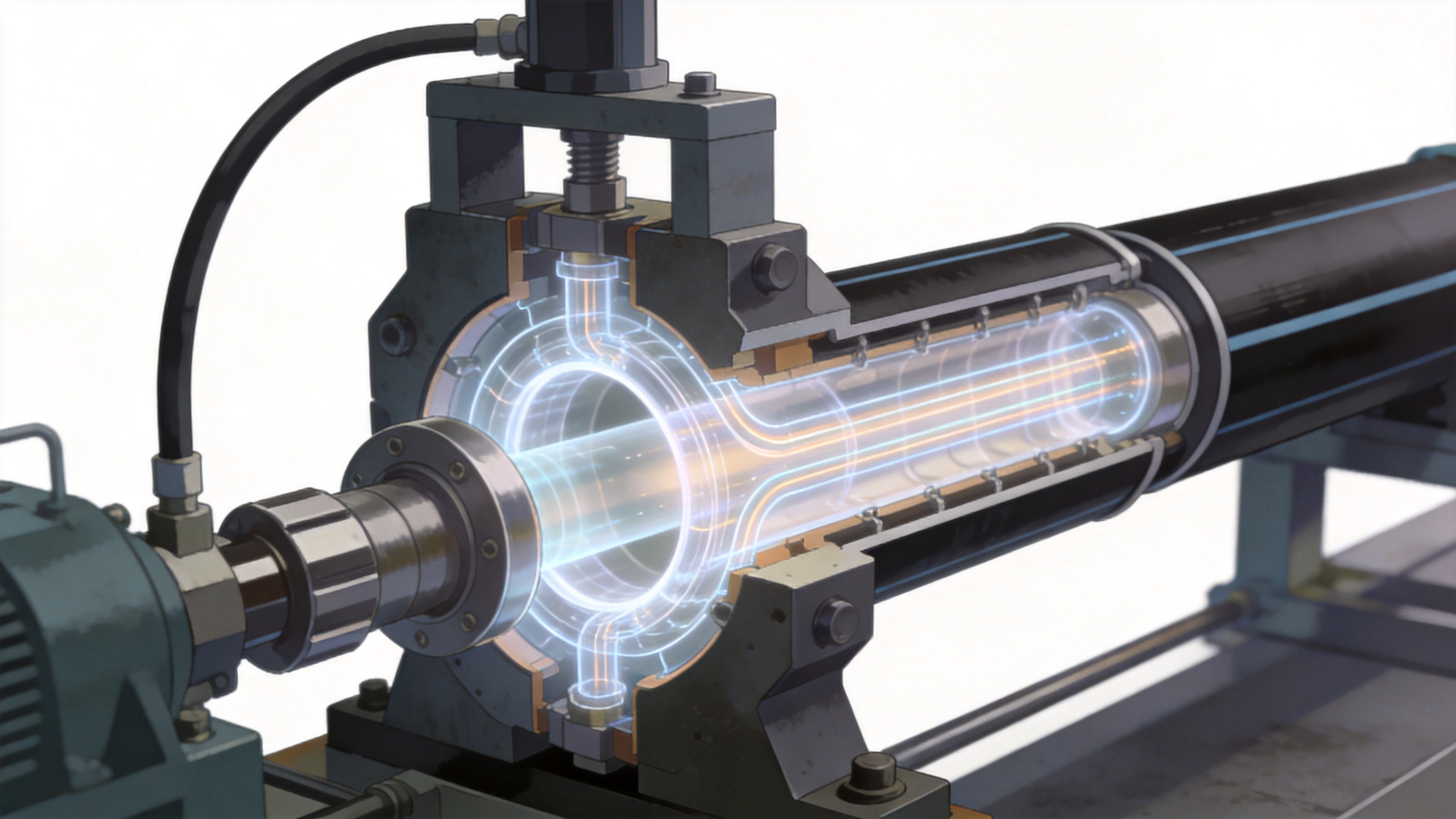
A PVC-O pipe extrusion die head therefore works as a distribution system. Its manifold and flow channels turn a single incoming stream into a ring of melt. If one route is longer, tighter, cooler, rougher, or more restricted than another, the material may not leave the die uniformly. Because rigid PVC is sensitive to heat history and shear, a change in resistance can also change local temperature and viscosity. The apparent symptom at the pipe can then be larger than the original imbalance inside the head.
How flow-path geometry creates balance
The first control is geometry. A sound PVC-O pipe extrusion die head is designed so that the melt sees a controlled resistance from the inlet to each point around the annulus. This involves the manifold shape, the transition into the ring channel, the support arrangement, the mandrel position, and the land. The aim is a passage with controlled pressure drop around the full circumference, not simply a wider channel.
Where the design uses support legs or a spider, the melt divides and then joins again. Those regions require careful shaping because the material must recombine without creating a stagnant pocket or an excessively long residence path. A compact, smooth transition can help the streams merge under controlled pressure. Conversely, abrupt dead zones may retain material longer than the main flow, while an abrupt restriction can raise local shear. Neither condition should be judged from appearance alone; the material recipe, output, and thermal profile must be confirmed.
The pipe extrusion die design also needs a transition that avoids sudden velocity changes. Gradual channel changes support a steadier pressure field, while the die land provides a final controlled resistance before the melt exits. A longer land is not automatically the right answer. Its practical value depends on the formulation, target diameter, output, and temperature window. The usable design decision is the one that produces repeatable distribution under the intended operating conditions.
Why mandrel centring matters
The gap between the mandrel and die ring defines the annular outlet. If the mandrel is off-centre, one side of the gap becomes tighter and the opposite side becomes wider. That alters local resistance immediately. Mechanical centring provides a baseline position; thermal centring recognizes that metal temperatures and expansion can change the effective gap during operation. For this reason, a PVC-O pipe extrusion die head should be evaluated after thermal stabilization, not only during a cold setup.
A segmented or adjustable mandrel can give technicians a way to correct a measured thickness pattern. The correction should be small, documented, and followed by enough residence time to see the outcome. If the same pattern returns after repeated centring changes, the cause may be upstream melt inconsistency, heater imbalance, calibration pull, or cooling asymmetry rather than the centring setting itself.
Thermal symmetry protects the flow field
Temperature zones are part of the flow system, not an accessory. If one side of the die body runs cooler, PVC melt near that wall can become more viscous and encounter higher resistance. A warmer sector may flow more readily but can also change surface behavior or thermal history. The appropriate temperature settings cannot be copied blindly from another line, because compound behavior, tooling size, output, and ambient conditions differ.
For a PVC-O pipe extrusion die head, check whether heaters, sensors, control loops, and insulation produce stable circumferential conditions. Compare actual readings with the set points, but also look for a repeatable thickness pattern around the pipe. A controller reading that looks acceptable does not prove that the steel and melt see the same condition at every sector. Confirm the instrument positions and any maintenance history before attributing a problem to die geometry.
Upstream conditions still decide what reaches the die
A die head cannot correct every upstream variation. Unstable screw speed, inconsistent feed, inadequate melt homogenization, screen-pack restriction, or changing compound condition can send an uneven pressure and temperature profile into the head. In PVC-O pipe production, it is usually more useful to trace the sequence than to adjust the PVC-O pipe extrusion die head first. Record output, head pressure, melt temperature where available, screw behavior, and the wall-thickness pattern during the same observation window.
This is the point where pipe extrusion die design and line operation meet. If pressure fluctuation occurs before the die, a geometric adjustment may conceal the symptom briefly without solving the source. If upstream data are stable and the thickness pattern stays fixed at the same clock position, centring, local heat balance, or a flow-channel restriction becomes a stronger hypothesis.
A practical check sequence for an even-flow problem
- Define the pattern. Measure wall thickness at consistent clock positions and record whether the thin or thick zone is fixed, rotating, or intermittent.
- Stabilize the baseline. Hold formulation, output, screw speed, haul-off, and cooling conditions long enough to separate a transient from a persistent issue.
- Verify thermal symmetry. Check heaters, sensors, insulation, and actual zone response around the PVC-O pipe extrusion die head.
- Inspect centring and tooling condition. Confirm mandrel position, adjustment records, cleanliness, and signs of damage or material build-up only after safe shutdown procedures.
- Review upstream pressure and melt consistency. Look for fluctuations that could enter the head before changing the pipe extrusion die design settings.
- Make one controlled adjustment. Change one relevant variable, allow the process to respond, and compare the new measured pattern with the baseline.
How this relates to PVC-O orientation
The PVC-O pipe extrusion die head establishes the preform’s initial wall distribution; it does not perform the orientation itself. However, uneven distribution entering the downstream stages can reduce the adjustment margin available to the orientation process. A line team should therefore assess die-head behavior together with sizing, cooling, and orientation conditions. Treating the die as an isolated component can lead to repeated adjustments without a clear causal record.
In practice, an even-flow result comes from a matched system: a die head with controlled flow resistance, a centred outlet, stable thermal zones, consistent incoming melt, and measured feedback from the pipe. If material conditions and target specifications are confirmed first, that system-level review gives a more reliable basis for selecting or tuning a PVC-O pipe extrusion die head.
Questions to confirm before specifying a die head
- Which PVC formulation, pipe diameter range, and wall target will the tooling handle?
- What output range and pressure window are expected at stable production?
- How will mechanical and thermal centring be checked and recorded?
- Which wall-thickness measurement method will validate circumferential distribution?
- What upstream and downstream conditions must remain fixed during commissioning?
These questions turn “even melt flow” from a broad claim into a commissioning plan. A properly matched PVC-O pipe extrusion die head can support stable distribution, but the final result should be verified on the intended material, tooling, and line configuration.