
 EN




A PVC-O pipe production operation does not train technicians by handing them a parameter sheet and expecting stable pipe the next day. The job is to teach cause and effect across the line: material preparation, extrusion, heating, orientation, cooling, inspection, and the handoff between shifts. From an operator’s viewpoint, the useful question is not “Which number should I change?” but “What changed upstream, what can I observe now, and who needs to verify the next move?”
For a PVC-O manufacturing team, training should be built around the actual process route and its approved work instructions. The exact settings depend on resin, pipe size, equipment design, and the site’s quality plan. That boundary matters. A technician can learn a sound method for checking conditions without being taught that one setpoint fits every line.
Start with a shared map of the process
Before a trainee runs equipment, a factory should walk through the line in process order. Explain what enters each stage, what the operator observes, what gets recorded, and what the next stage needs. Conventional extrusion creates the initial pipe form; the orientation stage then applies controlled deformation under defined temperature and speed conditions. This is why an observation at the orienting section cannot be separated from upstream melt and pipe condition.
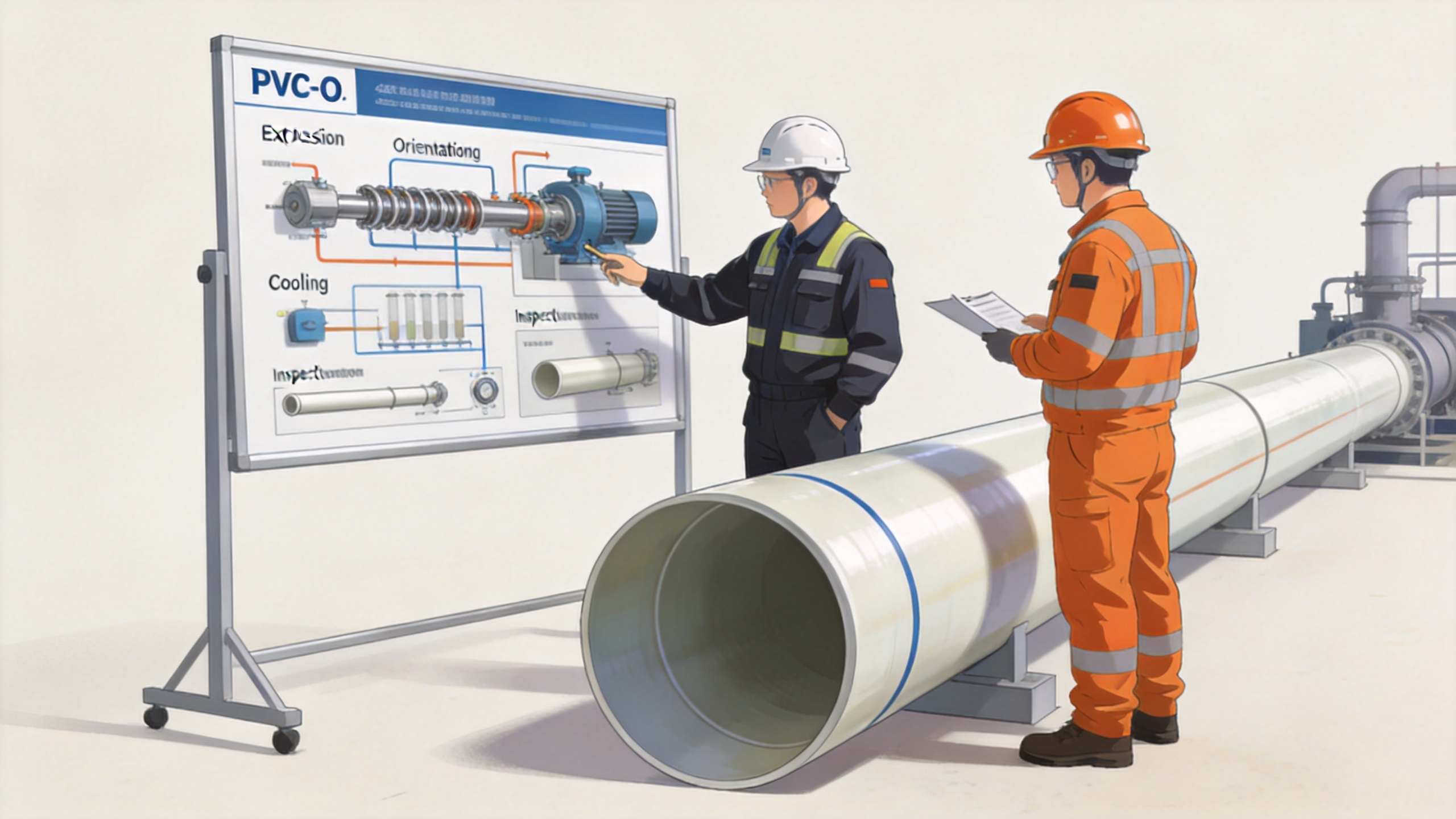
In a pvc-o pipe production process factory, a simple training board can show five linked checkpoints:
- Material and start-up: confirm the approved material, batch identification, drying or handling instruction where applicable, and production order.
- Extrusion and forming: observe melt stability, die-area behavior, pipe appearance, and the agreed process records.
- Conditioning and orientation: connect pipe temperature, deformation conditions, line speed, and expansion behavior instead of treating them as isolated controls.
- Cooling and sizing: check whether the cooling sequence supports stable dimensions and appearance before downstream handling.
- Inspection and traceability: make the link between samples, records, hold decisions, and the relevant product specification clear.
This map makes the factory easier to operate because each technician understands both the local task and the reason for the handoff.
Train by role before training by alarm
A PVC-O pipe operation usually needs different competence levels. A new operator should identify line zones, safety boundaries, standard records, and escalation points. A qualified operator should complete routine checks, compare observations with the approved range, and communicate changes precisely. A lead technician should coordinate a controlled response, verify documentation, and decide when engineering or quality personnel must take over.
For a pvc-o pipe production process factory, this role ladder is more useful than a long fault list. Alarms are equipment-specific; observation, recording, and escalation habits travel across products and shifts. Training cards should use the site’s own terminology so a trainee can say what was seen, where it appeared, when it began, and which approved conditions were checked.
Use short modules at critical control points
Extrusion and early pipe condition
At this module, trainers teach trainees to connect raw-material confirmation and stable extrusion with the pipe arriving at later stages. They should learn where the formal operating window is recorded, what a visual change looks like, and why an unexplained adjustment must be reported rather than copied from a previous run. A hydraulic pvc-o pipe machine may have its own controls and safety instructions, but trainees still need to understand the upstream/downstream relationship.
Orientation, temperature, and speed
The central lesson is that molecular orientation is condition-dependent. Technical references describe temperature, expansion rate, amount of expansion, and cooling rate as variables that affect the result. That does not create universal settings. It gives trainers a disciplined checklist: confirm the approved recipe, observe the pipe condition, compare records, and escalate deviations under the site procedure.
A pvc-o pipe production process factory can teach this module through supervised runs: the trainer narrates the observation, the trainee records it, and the team compares the record with inspection feedback. If line speed changes, trainees should ask what needs review before assuming the orientation section alone is responsible.
Cooling, cutting, and socketing
Cooling is not simply the last step on the line. It stabilizes the condition needed for downstream handling and inspection. A pvc-o pipe cooling bath machine should therefore be included in daily check routines: water condition, circulation-related observations, alarms, and the approved response path. Likewise, a pvc-o pipe socketing machine module should explain safe changeover, fixture checks, visual acceptance criteria, and traceability—without inventing a product-specific tolerance.
Turn quality checks into training evidence
A pvc-o pipe production process factory should make quality verification part of qualification, not an activity hidden in the laboratory. Technicians need to know what samples represent, where to find the inspection plan, and how to place material on hold when a required check is unresolved. ISO 16422 is a relevant reference family for oriented PVC pipe systems, but each factory must confirm the current applicable edition, customer requirements, and its internal test plan.
For each facility, a sign-off should show more than attendance. It can include a supervised start-up, a completed shift log, a demonstrated response to a simulated process change, and a review of an inspection handoff. This creates evidence that the technician can follow the process rather than merely repeat terminology.
Build escalation into every lesson
When a condition drifts, the operation needs a clear sequence: make the process safe, follow the authorized instruction, record the time and observation, isolate affected output if the quality procedure requires it, and notify the designated role. Trainees should not be rewarded for making undocumented corrections. They should be rewarded for recognizing when the process needs cross-functional review.
A practical exercise is a shift-handover drill. One technician gives the incoming operator the current product, confirmed settings source, observations, samples pending, maintenance notes, and open quality actions. The incoming operator repeats the critical points and checks the records. This small routine connects training with daily control.
A repeatable 30-day technician pathway
- Days 1–5: the factory covers safety, process flow, documentation, and supervised observation.
- Days 6–15: the trainee completes routine checks with a qualified operator and learns the approved escalation path.
- Days 16–25: the factory assigns supervised operation at defined stations, including cooling and downstream handling.
- Days 26–30: the trainee demonstrates records, handover communication, and response to a controlled scenario before role sign-off.
The pathway should be adjusted to the line and local procedures. In a trained PVC-O operation, stable output comes from technicians who can connect process stages, document what they see, and seek verification when conditions are uncertain. That is a stronger foundation than memorizing a list of numbers.