
 EN




DN315 is not a label to put on a quotation simply because a project needs a larger pipe. It is a working diameter that belongs to a wider conversation about hydraulic duty, pipe class, construction logistics, jointing, and the way a plant will control a PVC-O process. A dn315 pvc-o pipe extrusion line manufacturer should therefore start with the project scenario, not a catalogue comparison.
From a pipe-manufacturing buyer’s perspective, a DN315 line is usually considered when a project needs meaningful water conveyance capacity but also needs a pipe system that can be handled, transported, and installed within the contractor’s chosen method. The final fit still depends on the applicable design, local rules, material formulation, pipe series, and pressure requirements. ISO 16422 addresses PVC-O pipes and joints for piping and irrigation systems; the applicable edition and project requirements should be confirmed before a line specification is fixed.
Why DN315 needs a project-first decision
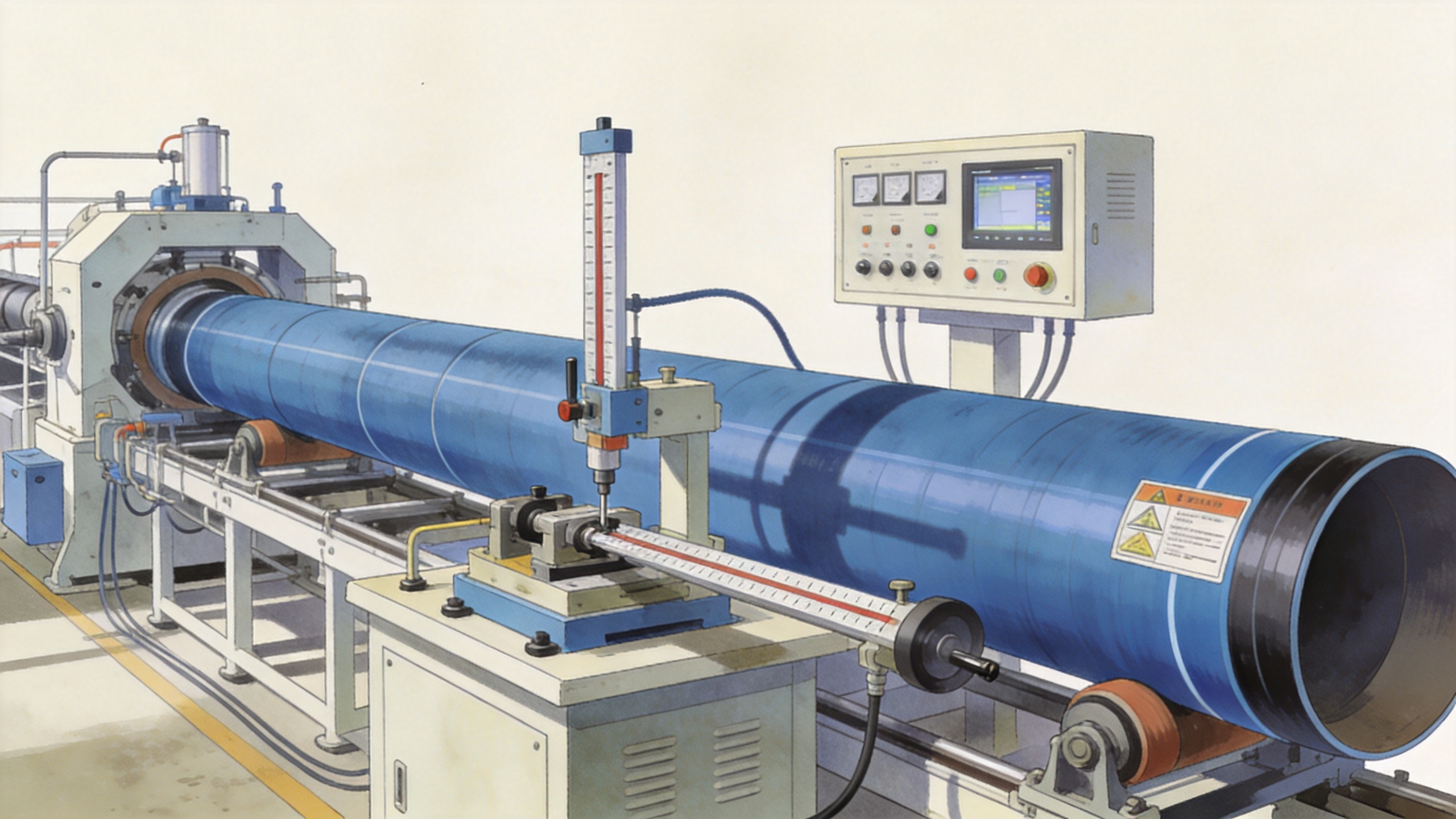
DN315 sits in a size range where upstream and downstream choices become tightly connected. The extrusion section, die tooling, cooling and orientation-related stages, haul-off control, cutting, inspection, and handling all need to be discussed as one production route. In other words, a large diameter pvc-o pipe extrusion line is not defined by nominal diameter alone.
The useful first question is not “Can the machine make DN315?” It is “What must the finished DN315 pipe do in this network, and what proof will the buyer need before acceptance?” That distinction helps avoid a familiar procurement issue: comparing one headline machine parameter while the project’s material conditions, output target, pressure duty, and documentation needs are still undefined.
Common project scenarios for DN315 PVC-O pipe
1. Municipal water transmission and distribution extensions
A municipal water pvc-o pipe extrusion line can be relevant where a utility or EPC contractor is extending a pressurized distribution network, connecting a new service zone, or replacing an undersized section between reservoirs, pump stations, or district branches. DN315 may be evaluated when the design flow is beyond a small local branch but does not justify the construction approach selected for a much larger trunk main.
For this scenario, the pipe producer should request the hydraulic design basis, pressure class, expected surge conditions, installation environment, connection method, and the required inspection or traceability records. A dn315 pvc-o pipe extrusion line manufacturer can then discuss a configuration around the actual pipe design instead of treating municipal use as a generic sales claim.
2. New residential or industrial development infrastructure
Large housing developments, industrial parks, logistics campuses, and mixed-use districts often need a main internal water route before the final service branches are installed. DN315 can be a practical discussion point when the network has a central ring, a supply corridor, or a phased build-out. In these projects, construction sequencing matters as much as the initial flow calculation.
The manufacturer’s input should focus on repeatable production conditions: the planned pipe range around DN315, anticipated changeovers, wall design, output requirement, marking data, and sample or acceptance plan. If the line is expected to serve more than one diameter, ask which sizes will dominate production. That answer affects tooling, changeover planning, downstream handling, and the realism of the output target.
3. Irrigation mains and agricultural water schemes
A water supply pvc-o pipe extrusion line may also be considered for pressurized irrigation mains that move water from a source, storage basin, or pumping point to field distribution zones. The application is not defined by agriculture alone. Elevation changes, duty cycle, water quality, pumping arrangement, seasonal output demand, and the installation method all shape the correct pipe and line discussion.
For an irrigation project, it is sensible to separate two decisions. First, confirm the network design and pipe requirements with the responsible engineering team. Second, translate the recurring production requirement into line inputs: resin and formulation conditions, diameter tolerance strategy, pressure-pipe testing plan, cutting length, socketing or connection workflow where applicable, and packing or yard handling. This avoids using a general irrigation label as a substitute for technical definition.
4. Rehabilitation or capacity upgrades in existing networks
DN315 is often worth reviewing when an existing water route requires more capacity, replacement due to service issues, or a new bypass section. These projects can be demanding because the manufacturing brief may be driven by site constraints: delivery windows, staged installation, tie-in scheduling, limited storage, or a need to coordinate with fittings and transition pieces.
Here, the production team benefits from a written coordination list. It should include target lengths, handling limits, marking information, dimensions that must align with the selected joint system, inspection records, and the process for retaining samples. A dn315 pvc-o pipe extrusion line manufacturer should not assume that a replacement project has the same requirements as a greenfield water main just because the nominal size is similar.
5. Regional water-supply corridors and interconnection sections
Some regional networks need intermediate-diameter links between local systems, tanks, pumping facilities, or treatment-area boundaries. A DN315 pipe may be examined for these interconnection sections when the design team is balancing capacity, route conditions, and installation practice. The scenario can involve long production runs, but it can also involve several release batches tied to civil-work milestones.
That changes the line conversation. The buyer should clarify whether the priority is sustained output on one specification, planned diameter changes, documented quality release by batch, or a combination of these. It is more useful to make those priorities explicit than to claim that one configuration is universally suitable.
What a DN315 line brief should contain
Before comparing a dn315 pvc-o pipe extrusion line manufacturer, build a concise requirements sheet. It gives engineering, purchasing, and production the same reference point.
- Finished-pipe definition: nominal diameter, wall design, target pressure class, applicable standard, and required test or inspection evidence.
- Material and process inputs: resin/formulation information, expected operating window, and the controls or records needed to investigate variation.
- Production plan: expected DN315 volume, other planned sizes, shift pattern, output expectation, planned changeovers, and scrap-recording method.
- Downstream scope: cooling, orientation-related stages, haul-off, cutting, marking, inspection, handling, packing, and any coordination point for socketing or joint preparation.
- Acceptance definition: trial conditions, measurement points, sample retention, documents, training boundaries, installation support expectations, and service contacts.
This list also makes supplier comparisons more meaningful. A low quotation cannot be assessed fairly if one proposal includes key downstream handoffs, controls, or documentation while another leaves them outside the scope.
How to compare manufacturers without reducing the decision to price
| Comparison area | Questions for the project team | What the supplier should clarify |
|---|---|---|
| Diameter and pipe range | Is DN315 the primary size, or one point in a planned range? | Tooling scope, changeover approach, and limits that depend on the agreed pipe design. |
| Process coordination | Which conditions must remain stable for the chosen material and output plan? | How extrusion, tooling, cooling, orientation-related stages, haul-off, and cutting are coordinated and monitored. |
| Quality evidence | What records are required by the customer, engineer, or standard? | Measurement, inspection, traceability, and trial documentation included in the supply scope. |
| Project delivery | What site utilities, layout, operator readiness, and civil coordination points exist? | Defined commissioning boundary, training scope, remote or site support assumptions, and exclusions. |
A dn315 pvc-o pipe extrusion line manufacturer should be able to turn this information into a conditional technical proposal. If a supplier gives an unconditional answer before receiving the pipe design and process inputs, the buyer has little basis for evaluating whether the proposed line matches the project.
Questions to settle before requesting a proposal
- Which project scenario is driving the DN315 requirement: municipal expansion, development infrastructure, irrigation, rehabilitation, or interconnection?
- Which standard, design parameters, and local requirements govern the finished pipe?
- What production mix is expected around DN315, and how frequently will the line change specification?
- Which quality records, tests, and acceptance documents must be available for each release?
- What site utilities, operator skills, handling equipment, and commissioning responsibilities are available?
Conclusion: match the line to the network task
DN315 PVC-O production is most relevant where a pressurized water project needs an intermediate-to-large pipe size and a plant needs a repeatable route for making that specification. Municipal extensions, development networks, irrigation mains, rehabilitation work, and regional interconnections are common starting points. The scenario alone, however, is not a line specification.
For a productive manufacturer discussion, provide the pipe design, material conditions, required records, production mix, downstream scope, and acceptance criteria. That gives the manufacturer a basis to propose a water supply pvc-o pipe extrusion line around the real project constraints—and gives the buyer a clearer way to compare the resulting proposals.