
 EN




A compact DN110 layout is not simply a shorter version of a larger pipe plant. For a buyer comparing suppliers of a DN110 PVC-O line, the layout must keep the extrusion, conditioning, orientation, cooling, haul-off, inspection, and handling stages connected without turning access or verification into an afterthought. The practical question is which interfaces can be tightened and which require protected working space.
From a PVC-O extrusion process adviser’s perspective, a dn110 pvc-o pipe extrusion line manufacturer should begin with the orientation route and the upstream melt condition, not with a single footprint number. A compact plan can be credible only after the resin formulation, target pressure class, pipe length, shift pattern, and site utilities have been confirmed. In other words, the line should be compact in travel distance, not cramped at the points where operators need to adjust, sample, or maintain it.
Start with the DN110 process sequence
The core sequence normally moves from material preparation and extrusion through die and sizing, then into the PVC-O orientation section, downstream cooling, haul-off, cutting, marking, inspection, and collection. The supplier should show this sequence as one connected material path. If the pipe has to reverse direction or cross a shared aisle, the drawing may look efficient while changeover and fault isolation become harder.
For DN110, keeping each station in order is usually more useful than trying to remove every gap. The orientation section needs room for guarding, control access, and safe observation. The same applies to the handoff from cooling to haul-off. Sensible compactness decisions are possible when those service zones are mapped before the machine bases are fixed.
A practical compact layout: five connected zones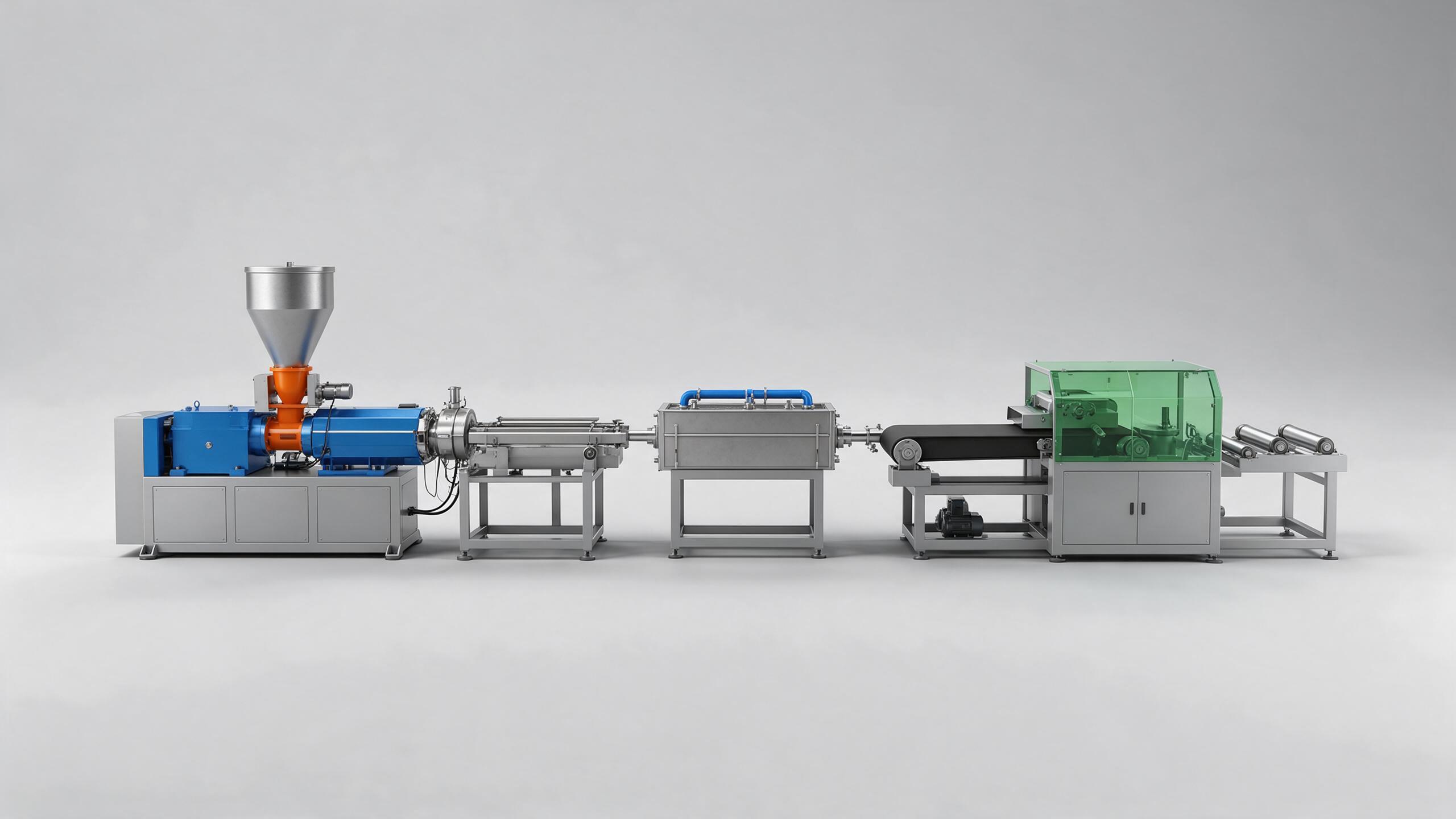
1. Resin and extrusion zone
Place material dosing, conveying, and the extruder so operators can replenish material and inspect the feed area without entering the main pipe path. The die and immediate sizing equipment should remain aligned with the extruder. This protects the straight-line arrangement that a dn110 pvc-o pipe extrusion line manufacturer needs for stable handoff into the next process stage. Confirm electrical cabinets, water connections, and access to heaters before reducing the side clearance.
2. Conditioning and orientation zone
This is the zone that generic 110 mm pipe-line layouts often overlook. PVC-O manufacturing depends on a controlled orientation stage; it should not be treated as an add-on squeezed between conventional downstream units. Ask the dn110 pvc-o pipe extrusion line manufacturer to identify the guarded length, the operator side, the maintenance side, and the locations for controls and monitoring. The answer should distinguish the equipment envelope from the space needed to work on it.
Published ISO 16422 material identifies requirements and fitness-for-purpose topics for PVC-O pressure-pipe systems. That does not establish compliance for an individual line or project. It does mean a compact concept should reserve space for the records, samples, and checks used to validate the required pipe characteristics under the applicable specification.
3. Cooling and pulling zone
After orientation, the cooling and pulling stages should be close enough to avoid unnecessary transport length but not so close that adjustments conflict. The proposed supplier should explain where water management, access doors, and pipe support are placed. Rather than asking whether the layout is “small,” compare the centerline, usable aisle width, and the workflow required for cleaning and inspection.
4. Cutting, marking, and quality zone
Keep cutting and marking downstream of stable pulling, with a clear place for dimensional checks and sample handling. This is a common place to preserve compactness without sacrificing traceability: arrange inspection beside the outfeed rather than creating a separate remote room. A dn110 pvc-o pipe extrusion line manufacturer should confirm how cut lengths, rejected pieces, and production records are handled before the final collection area is drawn.
5. Collection and logistics zone
DN110 pipe still needs a controlled landing and removal path. Leave a turning area for carts, bundles, or the customer’s chosen handling method. The compact layout should avoid mixing finished-pipe collection with resin replenishment or maintenance traffic. If the facility has limited length, it may be more productive to define the intended storage interval and removal frequency than to assume the outfeed can be shortened without consequence.
How the 90-250 mm range changes the discussion
The supplied phrase 90-250mm pvc-o production line is relevant because published PVC-O line information includes a 90-250 mm diameter range. It should not be used as evidence that every configuration has the same speed, output, or footprint. For a DN110 project, ask whether the proposed 90-250mm pvc-o production line configuration is optimized around DN110 or is a broader-range design that requires different tooling, changeover steps, or downstream settings.
A dn110 pvc-o pipe extrusion line manufacturer should state which dimensions are fixed by the orientation equipment and which change with diameter coverage. A broader 90-250mm pvc-o production line may be appropriate when future sizes matter, but it can introduce different layout allowances. Conversely, a DN110-focused solution may simplify the material path. Neither option is automatically preferable; the buyer should compare the actual scope, not a label.
Questions to put on the layout review
- What is the straight-line centerline from extrusion through collection, and where are the required operator and maintenance sides?
- Which utilities enter each zone, and can they be serviced without crossing the pipe path?
- How does the proposed layout separate normal operation, changeover, sampling, and maintenance?
- For the stated 90-250mm pvc-o production line range, what items change when DN110 is selected?
- What acceptance records, dimensional checks, and site conditions need confirmation before the layout becomes final?
Compare layouts by evidence, not by a single footprint
| Review item | Compact-layout question | Evidence to request |
|---|---|---|
| Process path | Is the DN110 path straight and uninterrupted? | Dimensioned general arrangement drawing |
| Orientation access | Can the team observe and service the guarded section? | Access-side and maintenance-clearance drawing |
| Utilities | Are water, power, and drainage routed outside normal handling? | Utility connection schedule |
| Quality workflow | Can samples and records be managed near the outfeed? | Inspection and acceptance checklist |
Many buyers first compare headline capacity or a total line length. A more reliable approach is to request a dimensioned drawing and then walk the material, operator, maintenance, and utility routes separately. That is especially important when evaluating a dn110 pvc-o pipe extrusion line manufacturer, because PVC-O orientation makes the downstream arrangement more process-specific than a generic pipe extrusion layout.
Conclusion: make compactness conditional
The right compact layout for a DN110 PVC-O project is usually a straight, zoned arrangement with protected space around orientation, utilities, inspection, and collection. A dn110 pvc-o pipe extrusion line manufacturer can help turn the site plan into a technical review when the buyer supplies the target pipe specification, resin details, available building dimensions, utility positions, and handling requirements. Before approving a 90-250mm pvc-o production line proposal, confirm its DN110 tooling, layout allowances, and verification plan. That keeps the decision grounded in the process conditions that actually govern the line.