
 EN




For a pvc-o pipe production process after extrusion, the useful cooling strategy is not simply “use colder water.” It is a controlled sequence: stabilize the freshly extruded preform without locking in distortion, condition it evenly for orientation, then cool the expanded pipe quickly enough to retain its new geometry. The cooling sections must respond to the same line-speed, wall-thickness, diameter, and orientation conditions as the rest of the line.
From an operations and maintenance perspective, the practical question is: does each cooling stage give the pipe the temperature profile it needs for the next stage? A pipe can look acceptable at the tank exit yet create ovality, unstable expansion, or delayed shrinkage later. In an advanced orienting pvc-o pipe manufacturing process, that is why cooling should be managed as a process link rather than as an isolated utility setting.
Start by separating the three cooling jobs
The phrase pvc-o pipe production process after extrusion can refer to several different events. Separating them prevents a common mistake: applying one aggressive cooling rule to all of them.
- Initial sizing and shape control: immediately after the die, cooling and calibration help hold a round, repeatable preform. The goal is stable geometry, not indiscriminate heat removal.
- Thermal conditioning before orientation: if the line uses a reheated preform, its wall must reach a sufficiently even orientation temperature through the thickness. A colder outside surface with a warmer core can make the following stretch less predictable.
- Post-orientation stabilization: after diameter expansion and molecular orientation, cooling fixes the expanded diameter and helps preserve the dimensional result before downstream handling.
Process literature commonly describes preform production followed by heating, orientation, and a cooling unit. It also describes conditioning PVC in a temperature range around 85–100°C before orientation. That range is useful context, not a universal recipe: the applicable window depends on formulation, diameter, wall thickness, orientation method, and the line’s actual thermal history.
The cooling strategy that usually works: staged, measured, and tied to line speed
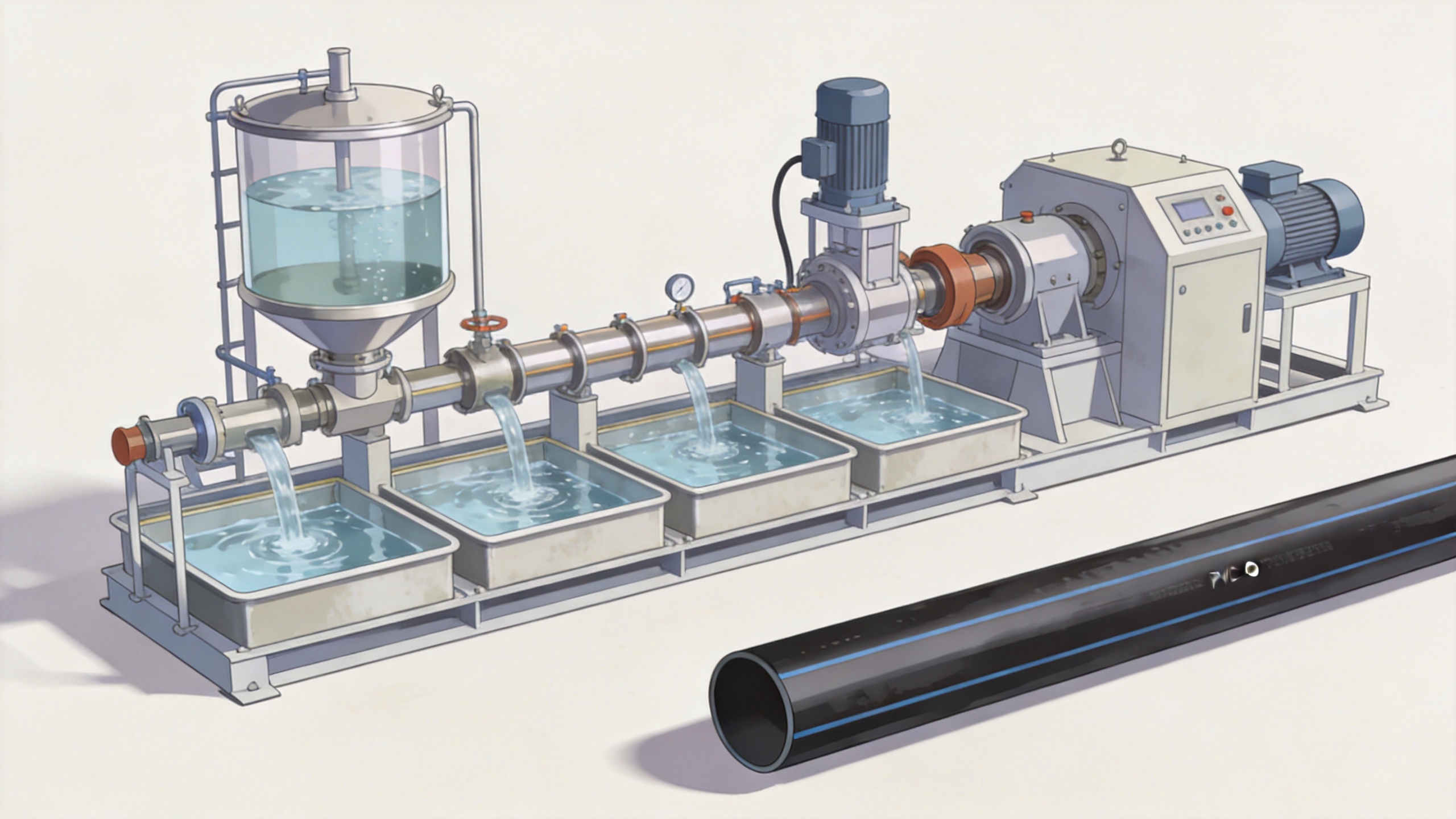
A staged strategy is generally more controllable than a single long, cold section. Give every zone a clear job and verify its response when production conditions change.
| Process zone | Primary purpose | What to monitor | What a poor balance may indicate |
|---|---|---|---|
| Post-die calibration | Set initial outside diameter and maintain roundness | Vacuum stability, water flow, diameter trend, surface appearance | Ovality, drag marks, unstable diameter |
| Preform cooling/conditioning | Deliver a repeatable thermal state to the next process step | Surface-to-core consistency, preform stiffness, speed changes | Uneven orientation response or variable wall distribution |
| Post-orientation cooling | Freeze the expanded geometry before haul-off and cutting | Diameter recovery, wall-thickness trend, residual heat, straightness | Delayed shrinkage, distortion, or handling marks |
For the pvc-o pipe production process after extrusion, start with stable flow distribution and repeatable tank conditions, then adjust one linked variable at a time. If line speed rises, residence time in each cooling zone falls. Compensating only by lowering water temperature can create a steep surface-to-core gradient. Before doing that, check whether the cooling length, spray coverage, circulation rate, vacuum condition, and downstream tension still match the new speed.
Why “faster cooling” is not necessarily the right first correction
Rapid cooling after successful orientation is important because it helps solidify the molecular alignment and hold the expanded diameter. Yet applying the strongest cooling too early can work against the preform’s thermal uniformity. In practical terms, a stiff skin around a warmer interior can make later behavior harder to read.
Strictly speaking, a temperature number alone does not explain a stable result. The cooling response has to be read together with upstream melt condition, die output, calibration, haul-off behavior, and the orientation stage. This is where automated control in pvc-o pipe production process can be useful: trend water temperature, flow, vacuum, line speed, and measured dimensions together instead of relying on a single setpoint.
When stable output and maximum throughput compete, rank the priorities before changing the cooling program. A short production trial with clear acceptance measurements is more informative than several simultaneous adjustments.
A practical commissioning sequence
Use a written sequence whenever a new size, formulation, or production rate is introduced. It makes it easier to distinguish a cooling issue from a melt, calibration, or orientation issue.
- Set a stable baseline. Record the material condition, pipe size, target wall profile, line speed, vacuum, water temperatures, flow indications, and ambient conditions.
- Confirm preform geometry first. Before judging orientation cooling, verify roundness, diameter stability, and surface condition after initial calibration.
- Check thermal uniformity before stretching. Observe whether the preform enters orientation with consistent behavior around the circumference and along the length. If it does not, investigate residence time and heat transfer balance before changing expansion conditions.
- Apply firm, even post-orientation cooling. The objective is to hold the oriented shape uniformly. Verify this with diameter, ovality, straightness, and wall-thickness records after the pipe has had time to stabilize.
- Change one variable per trial. For example, alter a zone flow rate or line speed, then compare the same dimensional records. Do not change cooling, stretch conditions, and haul-off tension together.
- Document the usable envelope. Record the settings and observations that work for each diameter and wall class. That record is more valuable than treating one setting as suitable for every product.
Symptoms that point to the cooling stage
Ovality increases after a speed change
First compare cooling-zone residence time and vacuum stability with the previous stable run. If the preform exits calibration with a drifting diameter, the later orientation stage is being asked to correct an upstream problem. In an advanced pvc-o pipe extrusion line technology setup, measured feedback is more useful than a visual judgment alone.
The pipe looks stable but dimensions move after cutting
Check whether the post-orientation cooling zone has removed heat evenly before haul-off and cutting. Delayed movement can also reflect uneven orientation or downstream tension, so review those records together rather than assigning the cause to cooling immediately.
One side of the pipe behaves differently
Inspect spray pattern, nozzles, water distribution, tank alignment, calibration support, and pipe path. Circumferentially uneven cooling often leaves a recognizable pattern in ovality or surface behavior. Cleanliness and consistent flow matter because a partially blocked circuit can mimic a materials problem.
What to specify when discussing a PVC-O line
For a pvc-o pipe production process after extrusion, the supplier discussion should cover more than nominal cooling capacity. Ask how cooling sections are zoned; how water flow, temperature, and vacuum are monitored; what dimensions are checked at each handoff; and how the controls accommodate different diameters, wall thicknesses, materials, and speeds. Bechton’s PVC-O production-line discussions can be organized around those process inputs so the extrusion, orientation, and downstream checks are considered together.
The conclusion is conditional, not universal: use controlled initial calibration, uniform thermal conditioning, and decisive but even post-orientation cooling. Validate the balance with production measurements, especially when changing speed or product size. That approach gives the cooling system a defined role in retaining pipe geometry instead of treating it as a generic water tank.