
 EN




A modular pvc-o pipe production line should not be judged only by its day-one output. For a pipe manufacturer planning future growth, the more useful question is which handoffs can be enlarged later without forcing a redesign of the extrusion, orientation, handling, and quality-control sequence. A modular layout can create room for growth, but only when the reserved capacity is defined against a real product mix, site condition, and acceptance plan.
From a pipe-manufacturing buyer’s perspective, expansion planning means comparing equipment fit, operating stability, scrap-control pathways, and service boundaries together. A combined pvc-o pipe line manufacturer can help organize that discussion, yet the purchaser should still document the intended diameters, wall classes, resin formulation, target markets, and production schedule before deciding what to reserve.
Start with the expansion case, not a larger equipment list
The first reserve for a modular pvc-o pipe production line is an agreed expansion case. Write down whether growth means a wider diameter range, more running hours, another pressure class, a second finishing stream, or a future automation module. These are different projects. A larger extruder, for example, does not by itself establish that the downstream orientation and cooling stages can support the later duty.
PVC-O production relies on coordinated radial and axial orientation. That is why upstream melt preparation, pipe formation, thermal conditioning, stretching-related equipment, haul-off, cutting, and inspection must be considered as one process chain. ISO 16422 is an example of a PVC-O piping-system standard that buyers may map against applicable local requirements; it is not a substitute for confirming the rules that govern a specific project.
Rather than asking whether a modular pvc-o pipe production line can simply “add capacity,” ask four traceable questions:
- What pipe sizes and production conditions define the future case?
- Which process module is expected to become the constraint first?
- Which utility, floor-space, and control handoffs must be installed now?
- Which performance checks will show that the upgraded line still meets the agreed requirements?
Reserve physical handoffs where retrofit work is disruptive
Floor space is more than an empty strip beside a machine. For a modular pvc-o pipe production line, it can include service access around a future module, material movement paths, coil or packaging handling, electrical-cabinet clearance, and a safe route for maintenance activities. A layout drawing should show the current configuration and the later configuration on the same scale, including operator stations and access doors.
Utility reserves deserve the same discipline. Record the available electrical supply, cooling-water capacity, compressed-air route, drainage, cable trays, and network points. The reserve should identify both the connection point and the verified capacity. Leaving a stub pipe or an empty cable tray may make later installation easier, but it does not confirm that the source system can carry the added load.
Specification changes are often described as adjustable without clarifying the transition conditions. Before treating a future size range as a reserve of the modular pvc-o pipe production line, confirm the tooling change steps, cleaning requirements, warming or cooling sequence, handling equipment, and time needed to regain stable production. Frequent changes can add flexibility while also adding operating complexity.
Keep the process modules expandable as a synchronized system
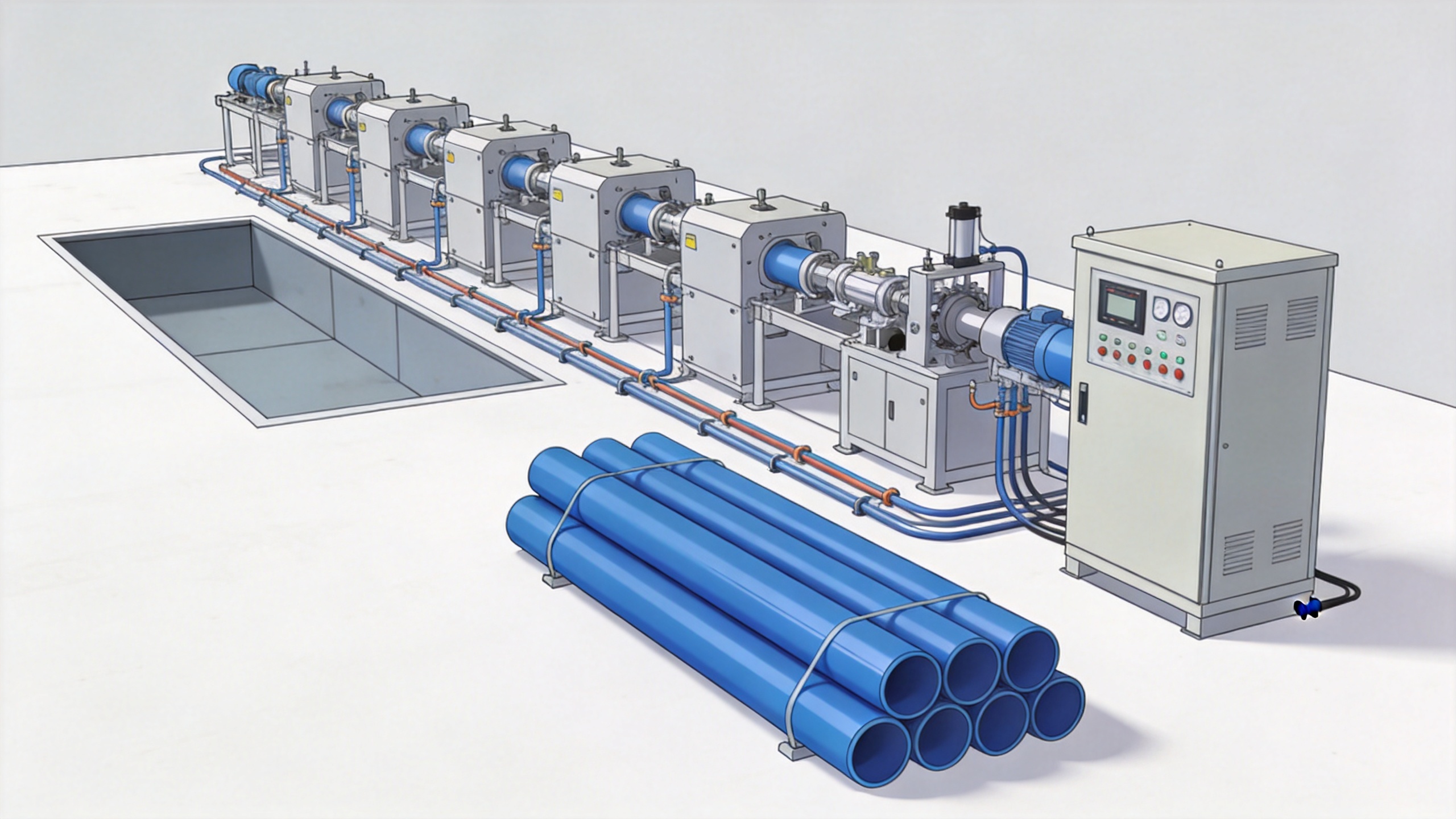
A practical modular pvc-o pipe production line plan separates modules for procurement and maintenance, while preserving the controls and mechanical handoffs that synchronize them. Review the following modules as linked decisions rather than isolated upgrades.
| Area to reserve | Questions for the future case | Evidence to retain |
|---|---|---|
| Extrusion and tooling | Can the future material and diameter range be processed within the defined operating window? | Material assumptions, tooling scope, and trial criteria |
| Orientation and thermal control | How will higher throughput or a new size affect temperature control and stretch coordination? | Process map, sensor list, and adjustment authority |
| Haul-off, cutting, and handling | Can downstream speed, support, and cut handling follow the proposed pipe condition? | Connection drawing and safe handling sequence |
| Inspection and data capture | Which dimensions, visual checks, or traceability records must continue after expansion? | Acceptance matrix and data-record template |
This matrix helps a combined pvc-o pipe line manufacturer and the buyer distinguish a genuine module boundary from a future claim that still needs engineering confirmation.
Plan the controls and records before additional equipment arrives
Control architecture is a central expansion reserve for a modular pvc-o pipe production line. Reserve I/O capacity, panel space, network addresses, sensor locations, recipe-management rules, and access permissions. More importantly, define how a new module will exchange speed references, alarms, interlocks, and production status with existing equipment. A spare terminal is useful only if the control logic and commissioning method are also understood.
When operating conditions change, record the time, material batch, pipe specification, adjacent process status, and adjustment made before drawing conclusions. These records allow a later upgrade to be assessed against comparable conditions. They also keep a planned capacity increase from being confused with a verified production result.
Use staged acceptance to protect the expansion path
A modular pvc-o pipe production line can be ordered with staged acceptance checkpoints. The first checkpoint confirms the installed scope. A later checkpoint can define the documents, utilities, tooling, controls, training, and test conditions needed before an added module is commissioned. This does not promise an outcome before commitment; it makes the technical and commercial scope visible while there is still time to clarify it.
Include an expansion register with named responsibilities: who supplies connection drawings, who verifies utilities, who provides the future tooling information, who updates the safety review, and who signs the final acceptance records. If these responsibilities are not written down, a seemingly modular option can become a collection of uncoordinated retrofit tasks.
A buyer checklist for expansion reserves
- Define the future product range and operating scenario for the modular pvc-o pipe production line.
- Map every upstream and downstream module that could constrain the future scenario.
- Reserve verified utility capacity and physical access, not only connection points.
- Document controls, interlocks, data fields, and commissioning responsibilities.
- Set staged acceptance criteria that relate to applicable pipe requirements and the planned scope.
- Review the plan with the production, maintenance, safety, and procurement teams before release.
The useful expansion possibility in a modular pvc-o pipe production line is therefore not a generic promise of more output. It is a documented path from today’s confirmed process to a future configuration, with the handoffs, evidence, and acceptance conditions needed to make that next step easier to evaluate.