
 EN




An upgradeable pvc-o pipe production line is not a collection of independent machines. It is a linked process: material preparation, extrusion, preform handling, molecular-orientation equipment, cooling, haul-off, cutting, inspection and controls all exchange material, motion or data. That is why the useful question is not simply, “Can this module be replaced?” It is: what changes at the handoffs when it is replaced?
For a plant evaluating an expansion, a modular pvc-o pipe production line can make phased investment more manageable. However, the change still needs an engineering review against resin formulation, target diameter and wall design, production rate, available utilities, safety circuits and acceptance criteria. From a pipe-manufacturing buyer’s perspective, a change is worthwhile when its scope, dependencies and validation plan are clear before an order is placed.
Start with the process boundary, not the equipment list
PVC-O manufacture adds a controlled molecular-orientation stage to preform extrusion. The upstream melt condition and preform geometry therefore affect what happens downstream, while downstream traction, temperature control and measurement influence whether the intended operating window can be held. In practice, an upgradeable pvc-o pipe production line should be reviewed in sections, then reviewed again as a complete chain.
First define the reason for modification. Is the priority a new pipe-size range, a different production rate, more stable dimensional control, a different degree of automation, or easier data collection? When several goals appear together, rank them. A module that supports one priority may introduce a constraint elsewhere. For example, a size-range change can affect tooling, downstream guides, traction settings and inspection setup—not only the forming head.
Modules that are commonly assessed for modification
1. Material handling and dosing
Feed, conveying, drying where applicable, dosing and blending arrangements are often among the first sections to assess. They may be modified when the material supply arrangement, additive handling, batch traceability or throughput requirement changes. The important boundary is the material specification: the line team should confirm how any change in formulation, moisture management or feeding consistency could influence melt behavior and the preform used for orientation.
Ask for a before-and-after material-flow diagram, the planned dosing range, cleaning procedure and the records used to release material to production. This is more useful than assuming that a feeder upgrade alone determines pipe quality.
2. Extruder, drive and melt-conditioning section
The extrusion section can be evaluated for drive capacity, screw and barrel configuration, thermal zones, melt-pressure sensing and process-control functions. It may be modified for a revised output target or a planned diameter range, but it should not be treated as an isolated capacity upgrade. The die, cooling and orientation-related equipment must be evaluated at the same time because they receive the resulting melt and preform.
A practical change request identifies the existing motor and drive data, screw geometry, resin grade, temperature profile, melt-pressure history and target output. If those inputs are not confirmed, claiming a definite production result would be premature. In this kind of project, it is usually more valuable to map the process handoffs than to focus on one catalogue figure.
3. Die head, tooling and calibration handoffs
Die-head and tooling changes may be relevant when a plant adds diameters, wall designs or a new preform geometry. These are high-impact modifications because the outlet condition connects directly to cooling, calibration and orientation. Review the die design with the intended material, sizing equipment, changeover procedure and downstream alignment. A tooling change may also require revised centering checks and a documented start-up sequence.
For a modular pvc-o pipe production line, interchangeable tooling can support a defined range of products, but the actual range has to be confirmed for the installed configuration. The term “modular” does not remove the need to verify heating capacity, pressure limits, alignment and operator access.
4. Orientation and thermal-conditioning equipment
This is the process area that deserves the closest joint review. Changes to heating, conditioning, orientation tooling, pressure or motion control may be considered when the product range or operating method changes. Yet they must be matched to the incoming preform and the downstream cooling and traction conditions. The production team should establish which settings are adjustable, which hardware items are exchanged, and which conditions require trial confirmation.
Do not describe an orientation module as universally adaptable. The relevant questions are more specific: What preform dimensions enter it? What temperature-control zones are available? What drives or feedback signals must remain synchronized? What test plan will confirm the new configuration? Those answers turn an upgradeable pvc-o pipe production line concept into an actionable project scope.
5. Cooling tanks, vacuum systems and water management
Cooling and sizing sections can be modified for revised diameters, cooling loads, water treatment arrangements or measurement needs. Assess tank length, circulation, temperature control, drainage, vacuum capability where used, pipe support and alignment with adjacent modules. A downstream cooling change may alter the stability of the pipe path, so its handoff to haul-off equipment needs attention as well.
Here, records matter. Compare the current utility availability and water conditions with the proposed duty. If the plant has not measured those conditions, the change remains a technical hypothesis rather than a confirmed production solution.
6. Haul-off, cutting and handling
Haul-off, cutting, marking, socketing where relevant, and downstream handling are often modular candidates when pipe lengths, diameter range, automation level or packaging flow changes. Check gripping method, speed coordination, cut-length accuracy, guarding, discharge height and communication with upstream controls. When a plant changes pipe size, it should also confirm change parts, guide spacing and recovery time after a format change.
A common mistake is to frame a cutter or puller replacement as a stand-alone task. The better approach is to test synchronization through the full line: preform delivery, orientation-related movement, cooling, haul-off and cut command.
7. Measurement, quality-data and control modules
Inline dimensional measurement, pressure and temperature sensing, recipe management, alarms, historian functions and HMI updates are particularly suitable for staged modernization. These modules can improve visibility of a process, but the upgrade scope should specify signal ownership, calibration, data retention, recipe access and cyber or network responsibilities. Measurement equipment needs a defined reference and a verification method; otherwise, more displayed data does not necessarily mean more reliable decisions.
The merchant profile for SUZHOU BECHTON PLASTIC MACHINERY CO., LTD states a PVC-O line scope of 110–630 mm and lists extrusion, cutting and metrology technologies in its site description. Treat that as an initial discussion point, then confirm the module options against the actual installed line and project requirements.
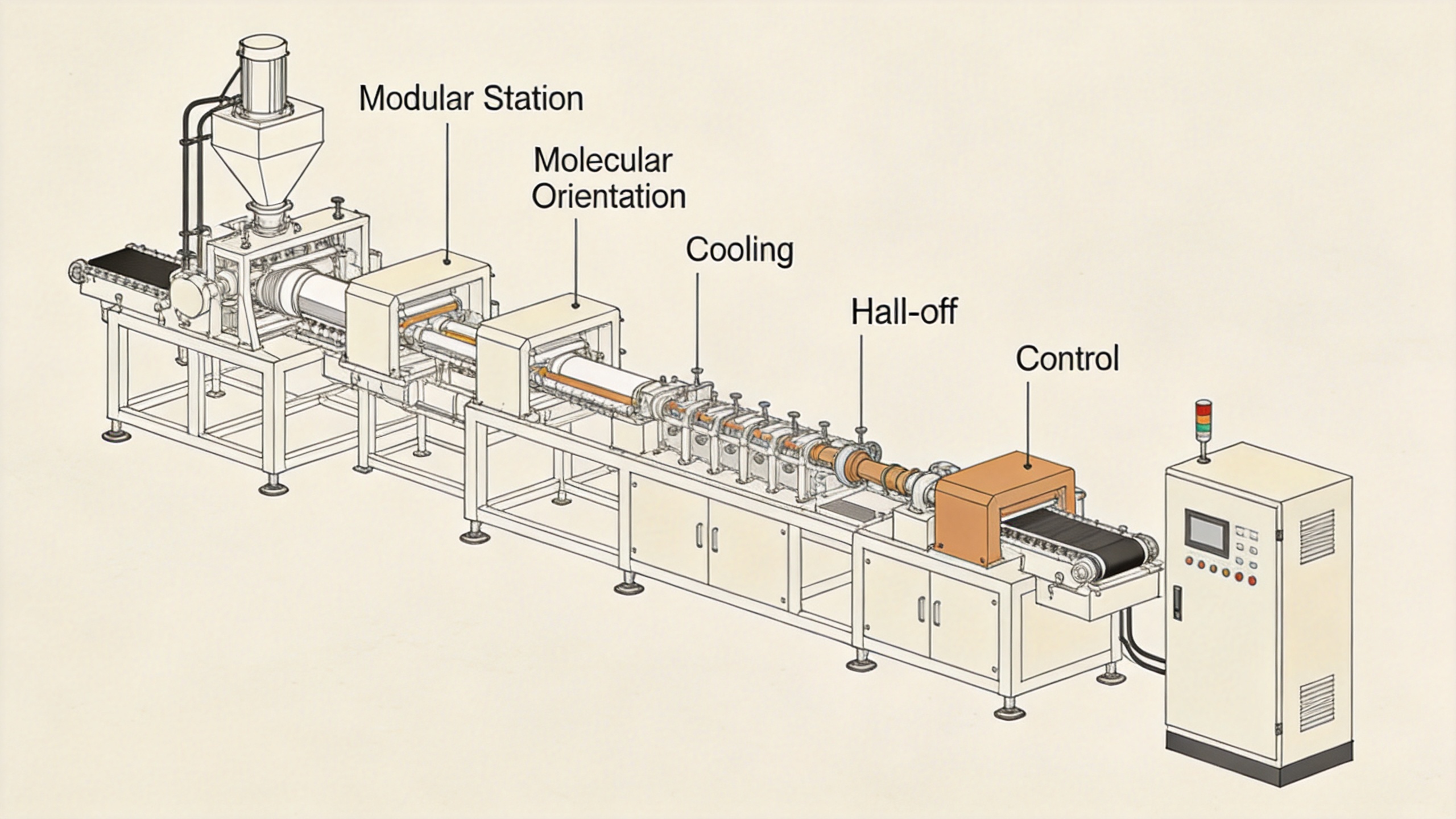
A decision matrix for an upgradeable pvc-o pipe production line
| Module | Typical reason to modify | Handoffs to verify | Evidence to request |
|---|---|---|---|
| Material feed and dosing | Material handling or traceability change | Resin condition, feed rate, cleaning | Material-flow plan and trial record |
| Extrusion and die | Output or product-range change | Melt condition, tooling, cooling, alignment | Process data and tooling layout |
| Orientation section | Preform or operating-window change | Thermal zones, motion, downstream handoff | Handoff list and validation plan |
| Cooling and haul-off | Diameter, speed or handling change | Utilities, support, speed synchronization | Utility check and run-off criteria |
| Controls and metrology | Automation or traceability improvement | Signals, calibration, recipes, access | I/O list and acceptance record |
What should be confirmed before approving a module change?
- Document the installed line configuration, serial identifiers, available utilities and current operating records.
- Define the target pipe diameter, wall design, material conditions, output objective and relevant market or customer requirements.
- Map the mechanical, thermal, electrical, pneumatic, water and control-system handoffs for the proposed module.
- Agree on the changeover parts, safety review, commissioning sequence and operator training requirements.
- Set measurable acceptance criteria and the test records required after commissioning. Where applicable, confirm the current revision and scope of standards such as the ISO 16422 series with the project’s technical team.
Build flexibility around verified handoffs
An upgradeable pvc-o pipe production line can often be developed in phases: material handling, extrusion and tooling, the orientation-related process section, downstream equipment, and controls can each be reviewed as possible work packages. But a modular plan succeeds only when every work package includes its handoffs and validation evidence.
If you are preparing a modification request, begin with the current line layout, product range, resin data, operating records and the change you want to make. Then ask the equipment supplier to identify which modules can be exchanged, which must be reconfigured, and which trials are required. That gives purchasing, engineering and production a shared basis for deciding whether the proposed modification fits the line.