
 EN




How low vibration pvc-o pipe extrusion line manufacturer reduce equipment shaking
When a PVC-O line begins to shake, the visible movement is only the symptom. A low vibration pvc-o pipe extrusion line manufacturer should treat it as a line-wide condition: a rotating drive can excite the frame, an off-centre melt stream can load the die unevenly, and a downstream unit can pull the pipe off the intended centreline. The practical aim is not to silence a machine for one shift. It is to identify the source, make one controlled correction at a time, and confirm that pipe dimensions and process stability remain acceptable.
For a PVC-O extrusion line production machinery project, that discipline matters because extrusion, temperature conditioning, orientation, haul-off and cutting work as a connected sequence. A vibration change at one station can appear later as draw instability, marking, cut-face variation or an unexpected change in wall distribution. The guide below is a production-floor method for investigating the issue safely and methodically.
Start with a stable baseline, not an immediate adjustment
Before changing bolts, speeds or temperature settings, record the condition in which shaking occurs. Note the affected unit, line speed, screw speed, melt or barrel temperature setpoints, haul-off speed, pipe diameter, noise character and the time after start-up when movement begins. A simple baseline helps distinguish a constant rotating-frequency problem from a load-related or temperature-related change.
Use safe observation practices and follow the machine supplier's lockout and operating instructions. Look for movement at guarded-frame interfaces, floor anchors, gearbox supports, motor feet, die supports, vacuum or cooling hardware, puller tracks and cutter supports. A phone video taken from a safe position can help compare the same point before and after a correction, but it does not replace appropriate vibration measurement where the site has that capability.
Separate the likely sources of shaking
1. Rotating drive and mechanical support
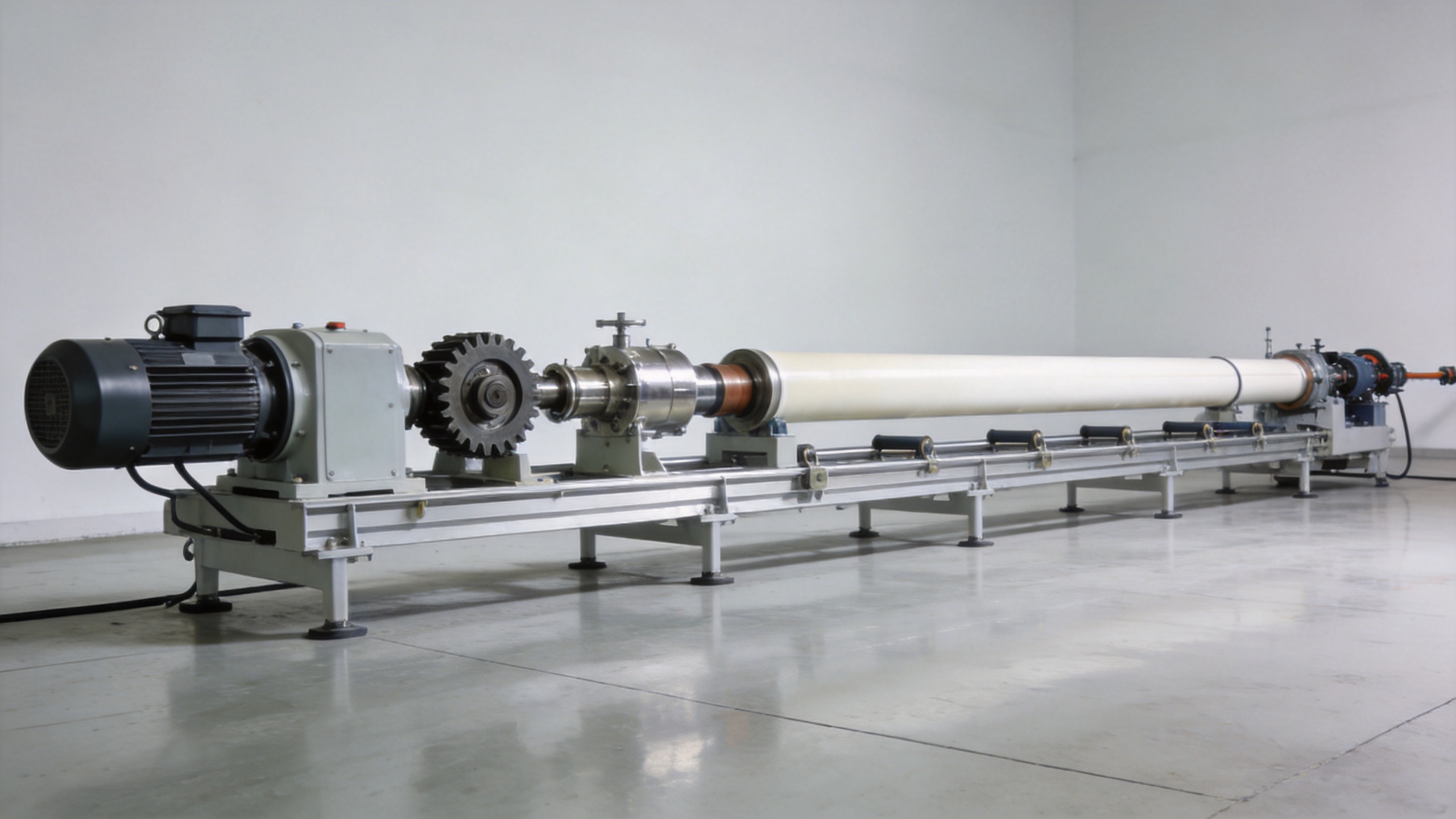
If vibration rises in step with screw or motor speed, begin with the motor, coupling, gearbox and extruder support path. Loose foundation fasteners, soft or damaged isolation pads, coupling misalignment, bearing wear and an unbalanced rotating part can all transfer force into the base frame. Check fastener condition and torque against the equipment documentation; do not tighten components to an assumed value. Inspect for oil leaks, unusual gearbox noise, heat, coupling wear or a changed shaft position.
Alignment deserves particular attention after transport, relocation, maintenance or a gearbox/motor intervention. General extruder-alignment guidance identifies barrel, gearbox and motor alignment as linked conditions. A low vibration pvc-o pipe extrusion line manufacturer will normally establish a reference centreline first, then verify the drive train with suitable alignment equipment rather than correcting one component in isolation.
2. Extruder, die and melt-flow loading
Shaking that changes with material throughput, head pressure or temperature may not originate solely in the motor. Review whether the issue began after a formulation change, screen-pack service, die change or major setpoint change. Pressure fluctuation, unstable feeding, contamination, a restriction, or uneven heating can alter the load seen by the screw and die. Confirm that feeder operation is consistent, heaters and sensors are responding as expected, and the die is properly supported.
Do not attempt to compensate for a mechanical issue by repeatedly increasing or decreasing temperature. Make a controlled process check, document the result and return settings to the validated operating window if the change does not identify the cause. This approach preserves a clearer record for the next diagnostic step.
3. Downstream alignment and pulling force
A long PVC-O line can look smooth near the extruder while the puller, orientation section or cutter applies side load farther downstream. Check whether the pipe travels on the intended centreline through cooling, conditioning and pulling stations. Uneven track pressure, a misaligned puller, worn rollers, a skewed guide or an out-of-square cutter can generate periodic movement that travels upstream through the product.
Inspect the puller contact pattern and compare left/right settings according to the machine documentation. Then observe whether vibration changes when downstream speed is adjusted within the approved production range. If it does, investigate tension and alignment before altering the extrusion drive. This is especially useful in PVC-O extrusion line production machinery, where axial draw and temperature state must remain coordinated.
A practical correction sequence
- Protect people and collect evidence. Stop the line when required by site procedure. Record the operating point and inspect guards, anchors, supports and visible interfaces.
- Confirm the foundation path. Check for loose anchor hardware, frame distortion, damaged pads and floor conditions. Correct only to approved drawings and torque specifications.
- Check alignment after mechanical work. Verify motor-to-gearbox, gearbox-to-extruder and extruder-to-die relationships with appropriate tools. Recheck after tightening because the assembly can shift.
- Review process stability. Compare feeder consistency, temperature response, pressure trend and motor load at the recorded baseline. Change one variable, then observe the response.
- Set the downstream centreline. Align guides, puller and cutter around the pipe path. Inspect wear parts and confirm symmetric contact where the design calls for it.
- Run a monitored verification. Bring the line back through a controlled start-up and monitor vibration, sound, current/load indication and pipe travel. Keep the before/after record.
Use pipe quality to verify the repair
A quieter frame is not enough evidence. After a correction, verify the characteristics your quality plan calls for, such as outside diameter, wall distribution, visual surface condition, cut quality and process consistency. PVC-O pipe standards, including the ISO 16422 series, provide a useful reminder that oriented pressure-pipe quality depends on controlled material and process conditions. Site-specific acceptance criteria and the applicable standard should govern the final evaluation.
Watch the first stable production length rather than judging the first few metres after restart. If the mechanical movement falls but wall distribution or draw behaviour shifts, return to the last confirmed condition and review the extrusion-to-downstream relationship. That outcome often means the visible shaking was coupled to line tension or temperature state instead of being a single fastener issue.
What to ask a manufacturer before commissioning or retrofit
- Which base, anchor and floor-flatness conditions are required for the selected line layout?
- How is alignment verified during assembly, installation and post-service recommissioning?
- Which operating signals should the team trend when vibration appears?
- What inspection intervals are recommended for couplings, supports, puller wear parts and cutter assemblies?
- How will the supplier support a staged test after the line is installed at the site?
BECHTON's documented scope includes turnkey PVC-O pipe production lines for 110–630 mm water-infrastructure applications. For a project discussion, provide the pipe range, resin/formulation context, desired output, layout constraints, foundation details and a description of any vibration pattern. Those inputs allow the engineering conversation to focus on a suitable support, alignment and commissioning plan rather than a generic machine comparison.
Keep vibration control as part of routine process discipline
The useful habit is to make vibration observable: retain baseline readings, note service events, inspect supports during planned maintenance and link every adjustment to a pipe-quality check. Low vibration pvc-o pipe extrusion line manufacturer support is most valuable when it connects mechanical setup with the actual PVC-O process sequence. With a clear baseline and a one-change-at-a-time method, a plant team can reduce unnecessary shaking while maintaining a controlled path for the pipe through the line.