
 EN




How Combined PVC-O Pipe Lines Switch Between Different Pipe Sizes
A combined PVC-O pipe line is often evaluated for its ability to cover more than one diameter range. The practical question is not simply whether the line has adjustable settings. It is how the complete process moves from one stable size to another without losing control of the preform, orientation conditions, cooling, handling, and inspection. For a combined PVC-O pipe line manufacturer, that means defining the changeover boundary before the project is specified.
From an operator and process-maintenance viewpoint, a size change is a coordinated sequence rather than a single adjustment. A line may have a common extrusion platform, but the parts that form, support, orient, cool, cut, and measure the pipe must still be checked as a system. The useful outcome is a documented route to a stable new size, not a claim that every diameter can use identical conditions.
Start with the Diameter Family, Not a Generic “Multi-Size” Label
Before discussing a modular PVC-O pipe production line, define the required outside diameters, wall-thickness range, material condition, pressure class target, output expectation, and changeover frequency. Those inputs establish whether one tooling family and one downstream arrangement can cover the intended sizes, or whether separate modules are more sensible. A combined PVC-O pipe line manufacturer should also clarify which items are exchanged, which are mechanically adjusted, and which must be confirmed during commissioning.
Public information on PVC-O systems shows that the technology is used across a wide diameter span, but a broad portfolio does not mean that one line can move across that span with no engineering boundary. Pipe size affects the preform dimensions, die geometry, calibration contact, support position, heating and orientation conditions, cooling demand, and cut-length handling. If raw material and target size have not been confirmed, a changeover promise has no sound process basis.
What Usually Changes When the Pipe Size Changes?
The changeover plan should separate physical tooling work from recipe and verification work. Conventional pipe extrusion references commonly identify the die-head tooling, calibration sleeve, and cooling-tank support rollers as changeover interfaces. For PVC-O production, those interfaces also need to be considered alongside the conditions that prepare and orient the pipe.
| Line area | Typical changeover action | What to verify before restart |
|---|---|---|
| Extrusion and die head | Install the diameter-specific die and mandrel set; confirm flow-path assembly. | Correct tooling identification, clean seating surfaces, fastener sequence, and a documented start-up recipe. |
| Calibration and cooling | Fit the relevant calibration tooling and reposition supports, guides, and cooling interfaces. | Pipe support is centered; water contact and vacuum-related settings are checked against the planned size. |
| Orientation section | Set the applicable geometry, heating, traction, and control parameters for the preform and target diameter. | Each setting is treated as a trial condition until the product checks show stable behavior. |
| Haul-off, cutting, and handling | Adjust contact points, clamp positions, cutting settings, and collection supports. | No interference, marking, or unnecessary load appears as the pipe passes downstream. |
| Measurement and records | Select the correct measurement range and inspection plan. | Measurements are traceable to the active size recipe and production lot. |
A combined PVC-O pipe line manufacturer should list these interfaces in the technical proposal rather than treating “combined” as a blanket capability statement. The exact modules depend on the selected line design, so the table is a planning framework, not a substitute for the supplier’s confirmed configuration.
Use a Controlled Changeover Sequence
A repeatable procedure reduces the chance that an otherwise correct size recipe is applied to an incorrectly prepared machine. A practical sequence is as follows.
- Close the previous run. Record the active size, resin or compound condition, stable operating observations, remaining material, and any unusual events. Do not carry an unexplained fluctuation into the next size.
- Isolate and prepare the line safely. Follow the site’s approved lockout, cooling, and access procedures before touching tooling or downstream modules.
- Exchange size-specific components. Clean and inspect contact surfaces; install the planned die components, calibration equipment, guides, supports, and cutting-related parts. Use the designated identification method so a similar-looking item is not fitted by mistake.
- Set mechanical references. Center the downstream path, check clearances, and confirm that rollers, guides, sensors, and handling equipment match the target outside diameter.
- Load the target recipe as a starting point. The recipe should identify its size and material basis. It should not be treated as a universal answer; melt condition, ambient effects, and upstream stability may still require controlled confirmation.
- Run a monitored transition. Observe the early pipe rather than judging only after a full production shift. Record the time of the change, active settings, material batch, observations, and any corrections.
- Release only after checks agree. Confirm the planned dimensional and visual checks, then continue with the inspection plan required for the order and applicable system requirements.
This is where a modular PVC-O pipe production line can be useful: it can make the mechanical interfaces more deliberate and easier to document. It does not remove the need to verify process stability after the modules are changed.
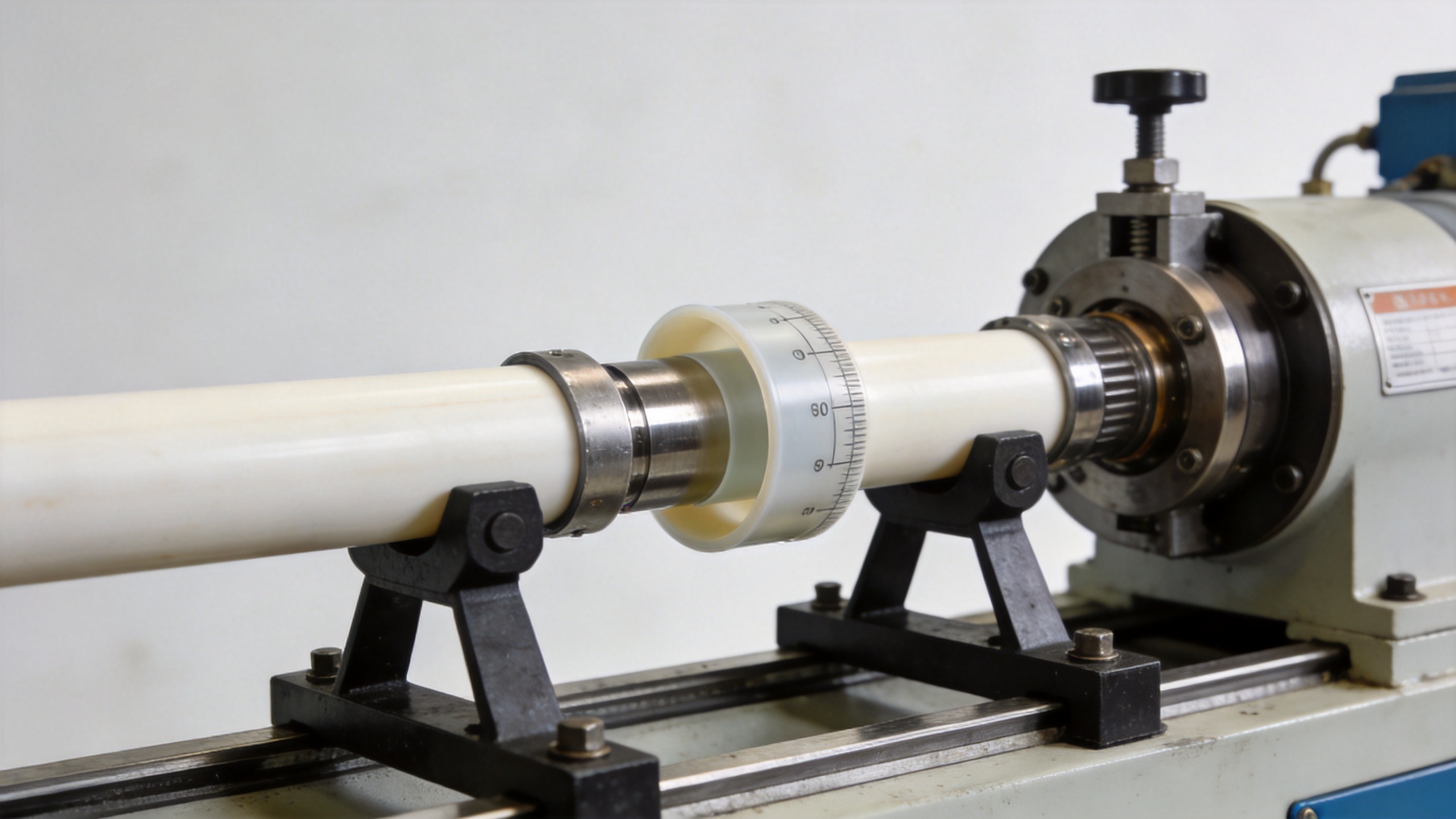
Why the Orientation Stage Needs Its Own Review
PVC-O is associated with molecular orientation, so a diameter switch must be reviewed beyond the extruder and cooling tank. The preform presented to the orientation stage, the temperature condition, the stretching-related controls, and the downstream pull all interact. A stable outer diameter alone does not establish that every relevant process condition is appropriate.
In this kind of work, it is usually more useful to ask whether the upstream and downstream stages are coordinated than to blame one component immediately. When a diameter or surface observation changes, first record the occurrence time, material batch, and neighboring process status. Then compare the observation with the active size recipe and the actual tooling arrangement. This approach gives the production team a traceable basis for adjustment.
For water-conveyance applications, the ISO 16422 series provides an international context for PVC-O pipes and joints. It should be used as a project verification reference where applicable, not as a reason to assume a particular line or a changed size automatically meets every project requirement. The specification, product design, testing plan, and local requirements still need confirmation.
Build the Recipe Around Verified Conditions
A good size recipe contains more than setpoints. It identifies the pipe size, tool set, material basis, key machine positions, start-up sequence, in-process checks, and the points at which an operator must stop and escalate. It also preserves the conditions under which the recipe was last stable. That is especially helpful when a line alternates between sizes rather than staying on one diameter for long runs.
- Give each diameter-and-tooling combination a clear revision-controlled identifier.
- Keep photos or controlled diagrams of correct mechanical reference positions where the site permits.
- Record changes to material grade, batch behavior, and any approved recipe adjustment separately from the base recipe.
- Define the first-piece and early-run checks before the changeover begins.
- Review transition scrap by its source: purge, start-up, dimensional instability, handling, or cut-off. A single total does not show where the changeover needs work.
When specifications must shift frequently, stability, adjustment flexibility, and the team’s ability to keep records deserve evaluation together. More adjustment range is not automatically a better fit if it makes the stable operating window harder to maintain.
Questions to Put to a Combined PVC-O Pipe Line Manufacturer
Use these questions to turn a general inquiry into a configuration discussion:
- Which diameter range is intended for one line, and what boundary conditions define that range?
- Which die, calibration, support, orientation, measurement, and handling elements are size-specific?
- Which changes are manual, semi-automatic, or recipe-driven, and what training or tooling storage is included?
- What checks are expected after a size switch before routine production resumes?
- How are recipe versions, tooling IDs, and changeover records managed?
- Which material, target pipe dimensions, output requirement, and site utilities must be supplied before the configuration is finalized?
BECHTON provides turnkey PVC-O pipe line discussions for water-infrastructure projects, with stated equipment coverage from 110 to 630 mm. That range is a starting point for a technical conversation; the actual size combinations and changeover plan should be confirmed against the product specification and project conditions.
Final Takeaway
A combined PVC-O pipe line switches between pipe sizes through planned tooling exchanges, centered downstream interfaces, a size-specific start-up recipe, and a monitored verification run. The point is not to make a universal claim about flexibility. It is to show exactly which conditions, components, records, and checks make a selected diameter transition repeatable. If you are comparing a combined PVC-O pipe line manufacturer, ask for that changeover map early; it will reveal far more than a generic multi-size description.