
 EN




How to confirm the research capability of a pvc-o extruder manufacturer
A polished brochure cannot tell a pipe producer whether an equipment supplier can investigate a process problem and turn the findings into a repeatable design. To assess a pvc-o extruder manufacturer, ask for a chain of evidence: a defined question, a documented trial, measurements taken under known conditions, and a design decision that follows from the results. A research team should also be able to explain what remains uncertain.
From a procurement perspective, the relevant unit is the whole process, not just the screw and barrel. A pvc-o extruder produces the preform; the subsequent orientation stage changes its structure under controlled conditions. The way these stages interact can influence the finished pipe. A supplier's research capability is more useful when its engineers can trace a problem across those interfaces.
Start with a project-specific research question
Before approaching a pvc-o extruder manufacturer, prepare a short technical brief. Specify the intended pipe sizes and application, raw material and formulation information that can be shared, target output, utilities, available space, and the applicable destination-market requirements. Identify which items are fixed and which can be explored. Without those conditions, even a well-documented trial may have little relevance to your plant.
Give each supplier the same problem. For example, ask how it would investigate wall-thickness variation after a material or size change. A useful response distinguishes possible causes in preform production, heating, orientation and measurement. It proposes what to observe first, what to hold constant and how to judge whether a change warrants another trial. It should not promise a result before the material and operating conditions have been reviewed.
Trace an idea from hypothesis to measured outcome
Ask the pvc-o extruder manufacturer for a redacted development report covering a relevant design change. Confidential details may be removed, but the remaining record should connect the problem statement to a drawing or control revision, a trial plan, observations and the decision taken. Dates, version identifiers and the responsible technical roles help establish continuity. A patent or presentation is a useful lead, not evidence by itself that a particular line can meet your specification.
Look for unsuccessful trials as well as favorable results. An engineering team that can describe why an earlier approach was rejected gives you a clearer view of its decision process. Ask which alternatives were considered, whether the result was repeated, and how the team separated a process improvement from a change in material, tooling or operator practice. A single attractive sample does not demonstrate repeatability.
Inspect the trial and measurement system
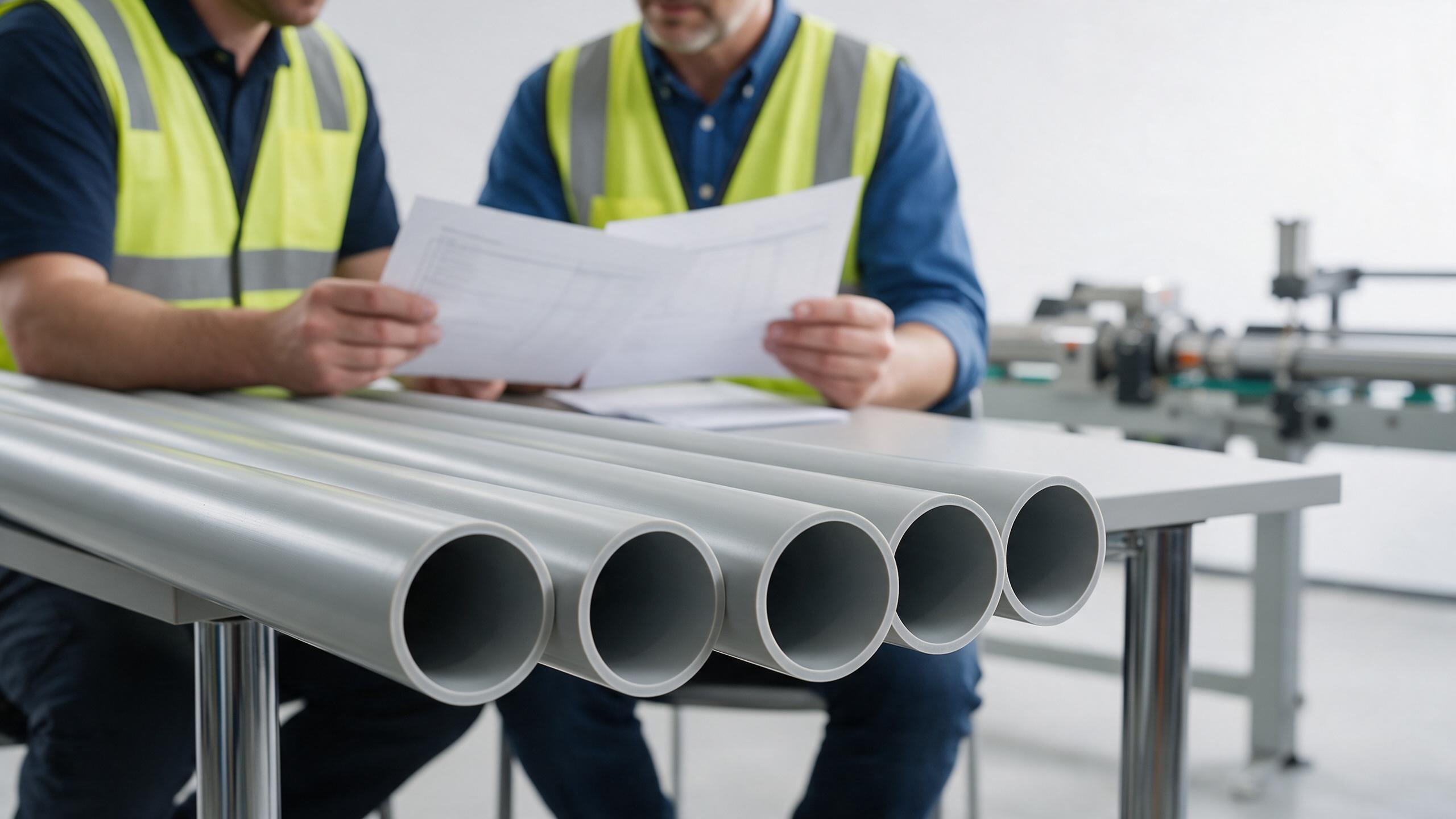
A pvc-o extruder manufacturer may use its own test line, a partner's facility, or both. Either arrangement can be useful if responsibilities and access are clear. Request the equipment list, the measurement methods, calibration records where applicable, and a sample test report. Ask which steps are performed in-house and which are outsourced. A laboratory photograph is less informative than a report showing how a sample was identified and evaluated.
For a pvc-o extruder trial, agree beforehand on material identification, tooling, size, operating conditions, sampling points and acceptance criteria. Record start-up and steady-state periods separately. Ask how the team measures dimensions and wall distribution, how samples are selected, and what happens to discarded material. Compare outcomes only when test boundaries and calculation methods are consistent; a short run and a long production run answer different questions.
Finished-pipe testing needs its own scope. ISO 16422-2:2024 specifies characteristics of solid-wall oriented PVC pipes for piping systems. Check the edition, local adoption and requirements relevant to your application with the appropriate technical and regulatory authorities. A standard reference does not mean that a machine or supplier is certified, nor does one passing sample establish conformity across every size and production condition.
Ask engineers to explain the complete process
During a technical meeting, ask the pvc-o extruder manufacturer to sketch the sequence from material preparation through preform extrusion, orientation, measurement and cutting. Then introduce a plausible change, such as a different target diameter. Which settings or components might need review? What measurements would indicate whether the preform is suitable for the next stage? Which issues require a trial rather than a calculation?
Listen for interfaces and limits rather than a list of claimed features. If an answer focuses exclusively on the pvc-o extruder, ask who is responsible for the orientation equipment and how the two teams share data. A clear answer should identify the owner of each connection and explain how an abnormal result moves from observation to diagnosis. Treat a refusal to discuss boundaries, even under a reasonable confidentiality agreement, as a reason for further inquiry.
Check people, partners and ownership of the work
Research capability is not simply a headcount. Ask who leads process development, who designs tooling and controls, and who validates the pipe. Request the roles and relevant experience of the people who would work on your project, without requiring disclosure of confidential personnel records. Ask how production, commissioning and service teams feed field observations back into design reviews.
When a pvc-o extruder manufacturer relies on an outside laboratory or technology partner, clarify the scope of each relationship. Who writes the test plan? Who owns the design changes? Who can modify the controls after installation? Obtain a contact and escalation route for technical issues, along with the documents you will receive. An external partner can add expertise, but its existence alone does not establish the supplier's own contribution.
Turn research evidence into contract terms
A demonstration is most useful when its conditions are agreed before the visit. Define the material, intended size, sample schedule, instruments, operating window and observer access. Set measurable criteria for the agreed trial, specify how deviations will be recorded, and distinguish a factory demonstration from final acceptance at your site. If a test cannot represent your conditions, document the gap instead of treating the trial as proof of performance.
Ask the pvc-o extruder manufacturer for a deliverables list: process and equipment documentation, revision history, trial data, training scope, spare parts information and the procedure for unresolved issues. Include who pays for additional testing, what information can be retained, and how intellectual property and confidentiality will be handled. Legal and engineering teams should review the wording together.
Compare suppliers with an evidence matrix
Use the same questions for every candidate. Mark each item as verified, partially supported or not yet demonstrated, and record the source and date. Give particular weight to relevance to your material and pipe specification, traceability of trial results, ability to explain process interactions, and the support available after commissioning. An older report for a different pipe size may be informative but should not be scored as direct proof for your project.
Finally, ask the pvc-o extruder manufacturer to identify the next experiment needed to resolve the largest open question in your brief. The quality of that proposed experiment often reveals more than a general claim about innovation. Suzhou Bechton Plastic Machinery works in PVC-O production equipment; use the same evidence requests with its team and with any other candidate. Make your purchase decision only after technical evidence, contractual scope and site conditions have been reviewed together.