
 EN




What storage conditions protect high pressure pvc pipes before construction
High pressure PVC pipes can arrive in good condition and still be damaged before the first trench is ready. A stack left on uneven ground, a tight cover in direct sun, or a forklift contacting a socket can turn a routine delivery into an inspection problem. A good storage plan starts with the pipe manufacturer's instructions for the specific product, diameter, packaging and expected time on site.
For a site team, the immediate priorities are a level, supported storage area, shade with ventilation, careful handling and a clear process for holding suspect material. The same checks apply to PVC pressure pipe and, where confirmed by the supplier, oriented PVC (PVC-O). Do not assume that every PVC pipe has the same storage limits or joint details.
Choose a stable place clear of site traffic
Set aside a dry, reasonably level area with enough room for unloading and access to each bundle. Remove stones, debris and objects that could press into the pipe wall. Keep high pressure PVC pipes clear of vehicle routes, excavation edges, falling materials and places where other deliveries are likely to be stacked on top of them. A convenient position on delivery day may become hazardous once machines and trench spoil arrive.
Use the supplier's original cradles or suitable supports under the pipe. Supports need to hold the length evenly without concentrating load at a narrow point. Do not let the barrel sag between supports, and do not rest the weight of the stack on projecting sockets. For loose lengths, follow the supplied stacking arrangement and restrain the stack against rolling. If bundles are stacked, align the supporting frames as the supplier directs.
The Uni-Bell installation guide for gasketed-joint PVC pressure pipe gives an eight-foot maximum stack height for its covered pipe. That number is not a universal permission to stack any product to that height. Packaging strength, ground conditions, local safety rules and the actual manufacturer's instructions may require a lower limit. Ask the supplier before stacking unfamiliar bundles.
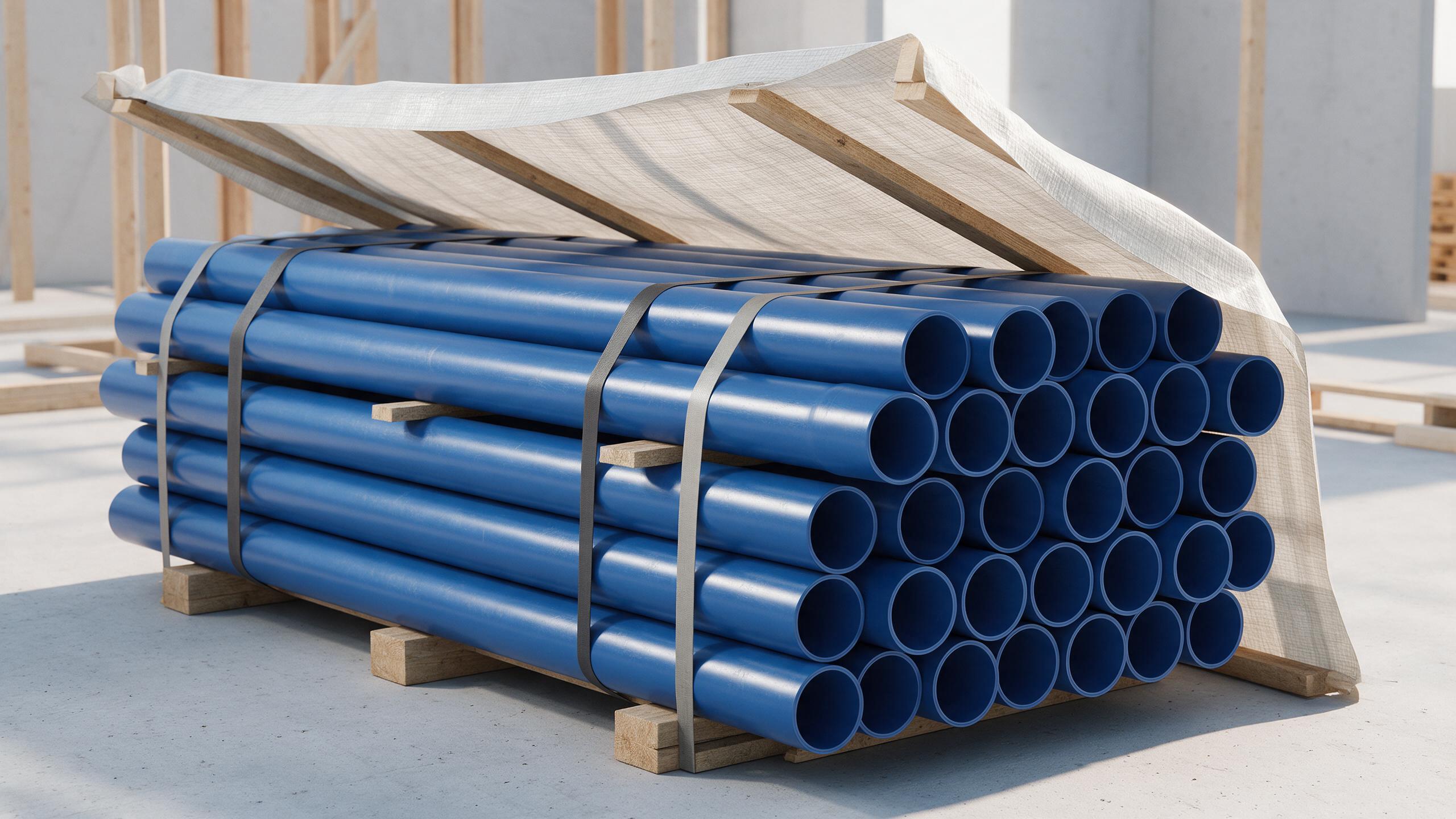
Control sunlight and heat without trapping hot air
For outdoor storage, shade high pressure PVC pipes with an opaque, light-colored cover or place them in a ventilated shelter. The cover should shield the material from direct sun while leaving room for air to circulate. A cover wrapped tightly around a bundle can trap heat; check that it stays in place during wind without closing off ventilation or rubbing against the pipe.
Keep the storage area clear of heaters, welding operations, hot exhaust and other concentrated heat sources. The PVC piping design guide published by the Plastic Pipe and Fittings Association recommends an opaque, light-colored cover with ventilation for prolonged outside storage. How long a specific pipe may remain outdoors depends on its formulation and supplier guidance; record arrival dates and ask for the applicable storage period instead of assuming that a cover gives unlimited protection.
Temperature changes can affect pipe dimensions and handling behavior. In cold weather, handle lengths with extra care because impact resistance can be reduced. In hot weather, do not move a bundle simply because its wrapping is intact; inspect the supports and check for distortion first. Follow the product's installation instructions when allowing for temperature at assembly.
Protect pipe ends, sockets and seals
Keep caps or protective packaging in place when supplied, and keep open ends clear of soil, water and debris. Store fittings, gaskets and joint accessories in their original packaging under the conditions specified by their manufacturer. Separate them from fuel, oils, grease and other chemicals unless their compatibility has been confirmed. Do not substitute an unapproved lubricant for the joint system.
With high pressure PVC pipes that have sockets, arrange the layers so sockets are not carrying the weight of the barrels. The exact arrangement depends on the packaging and joint design. Check that protective caps remain in place after rain or wind, and keep the identification marks visible where practical. A clean socket is useful, but it is not proof that a damaged joint is acceptable.
Unload gently and inspect before accepting
Before unloading, compare the delivery note and pipe markings with the project order. Confirm the pipe type, nominal size, pressure class and relevant batch information. A label such as pvc pipe for high pressure does not by itself establish suitability for a particular duty: the design pressure, operating temperature, surge conditions and applicable project specifications still need checking.
Use the lifting method and equipment specified by the supplier. Suitable textile slings or approved equipment can spread the load; avoid hooks or forks bearing directly on pipe surfaces or inserted into pipe ends. Do not drop, drag or push lengths across the ground. Keep people clear of suspended loads and follow the site's lifting plan. For large PVC-O sizes, obtain the manufacturer's handling instructions before selecting sling positions and equipment.
Inspect high pressure PVC pipes on arrival and again before installation. For high pressure PVC pipes held over several weeks, repeat visual checks after any movement of the bundle. Look for cuts, gouges, cracks, flattened areas, distorted ends, damaged sockets and missing identification. Photograph and label anything suspect, then move it to a designated hold area. The supplier or project engineer should decide whether the section can be used, repaired under an approved procedure or rejected; a visual check alone cannot establish remaining pressure capacity.
Manage storage time and handover
Once high pressure PVC pipes are placed in the yard, assign someone to check the storage area after severe weather and whenever bundles are moved. Note the delivery date, location, product designation and any damage report. Rotate stock where the manufacturer's instructions and project traceability rules permit, and retain the documents needed to identify each batch at installation.
Before releasing a bundle, inspect the ground supports, cover, sockets and markings. Remove a cover carefully so it does not pull a loose length from the stack. Bring only the required material to the work area, keep the rest protected, and maintain clean ends until jointing. If a cover has failed or a bundle has been exposed for longer than the specified period, isolate the affected lengths and seek written guidance rather than deciding on appearance alone.
A practical storage checklist
- Confirm the manufacturer's storage, stacking and handling instructions for the exact pipe and packaging.
- Provide level ground, appropriate supports and restraints; protect sockets from the stack load.
- Provide shade and airflow; keep high pressure PVC pipes clear of heat sources and moving equipment.
- Protect joint components and ends from contamination, and check chemical compatibility.
- Record the batch and arrival date, inspect at delivery and installation, and hold any suspect material for review.
These steps help preserve the condition in which pipe reaches the installer; they do not replace the project specification, pressure design or the manufacturer's acceptance criteria. For manufacturers of PVC-O pipe, clear product-specific packing and storage instructions are an important part of the handover from production to the construction site.