
 EN




What connection methods fit a pvc high pressure pipe
A pressure pipe can have an impressive marking and still be the wrong choice for a joint. For a buyer or manufacturer selecting a pvc high pressure pipe, the useful question is not simply “Which connection holds the most pressure?” It is “Which complete joint is approved for this pipe, fluid, temperature and installation?” The answer may be a gasketed socket, a solvent-cemented socket, a mechanical coupling or a flanged connection. Each solves a different connection problem.
Start with the pipe material and end design. Conventional PVC-U and molecularly oriented PVC-O are not interchangeable just because both contain PVC. For PVC-O, use joining methods and fittings explicitly approved by the pipe and joint suppliers; do not assume that solvent cement, threading or a fitting intended for another pipe series is suitable.
Compare the connection as a system
A useful selection sheet for a pvc high pressure pipe identifies the pipe outside diameter and tolerance, material, pressure class, operating and transient pressures, fluid, temperature range and expected movement. Then ask for the corresponding joint details: seal material, fitting pressure rating, dimensions, assembly instructions, axial restraint and test procedure. A pressure rating for a straight pipe does not automatically apply to a valve, flange or coupling attached to it.
| Connection | Where it may fit | Key decision |
|---|---|---|
| Gasketed bell and spigot | Buried water mains with a compatible socket and seal | Verify insertion, gasket compatibility and separate thrust restraint |
| Solvent-cemented socket | Compatible PVC-U pressure pipe and purpose-made fittings | Confirm approved materials, joint preparation and pressure-test waiting time |
| Mechanical coupling | Repairs, transitions or connections where cutting and assembly access are limited | Match outside diameter and verify sealing and restraint separately |
| Flanged joint | Valve chambers, equipment connections or planned disassembly | Confirm flange rating, gasket, support and bolt-tightening sequence |
These are categories, not universal approvals. Confirm the specific high pressure pvc pipe fittings and pipe combination with the supplier and the project engineer before ordering.
Gasketed sockets: sealing is not restraint
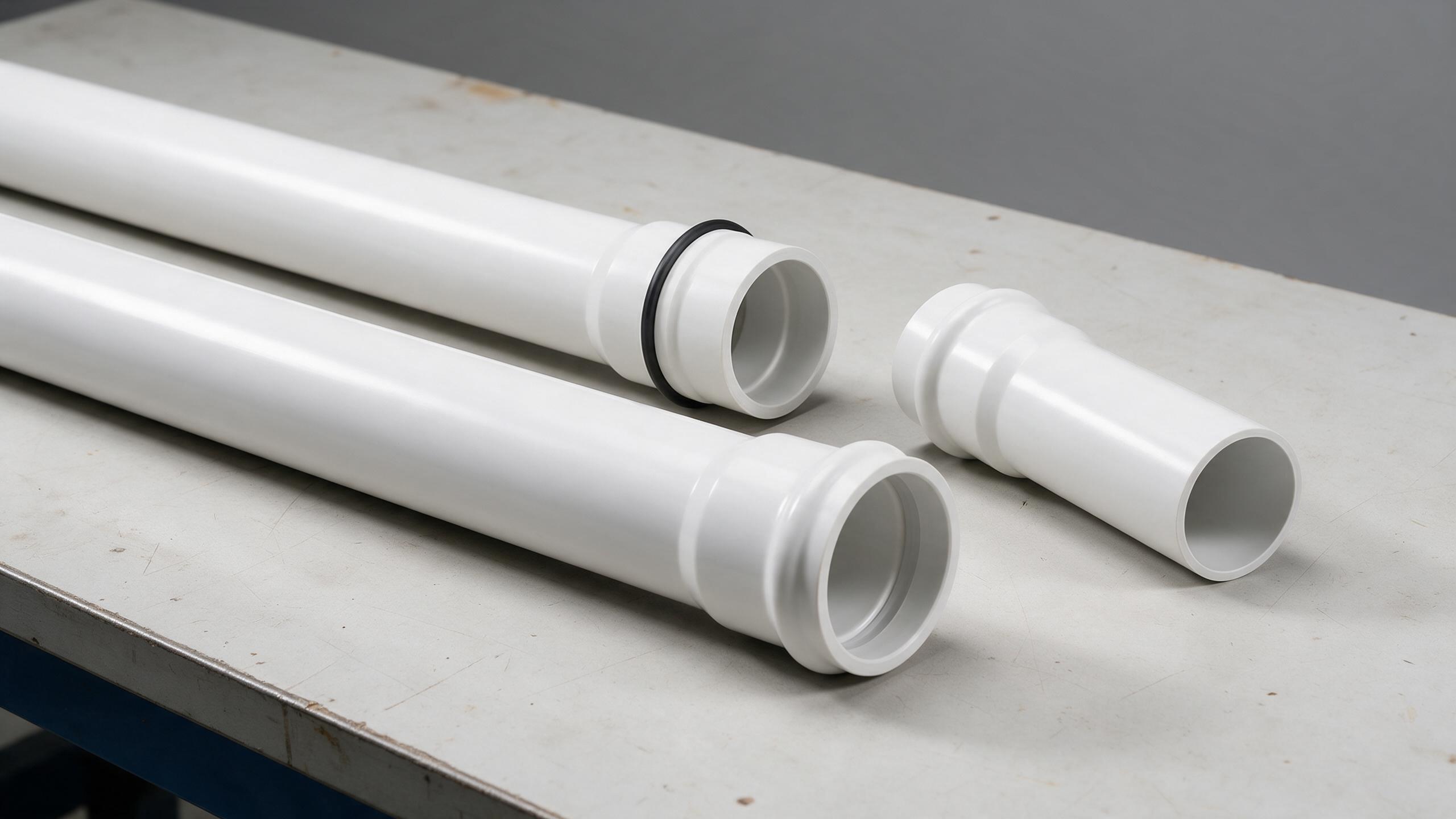
With a compatible gasketed bell, the spigot enters a socket containing an elastomeric seal. This arrangement is common in buried water networks where the system is designed for it. The seal accommodates the joint as specified by its manufacturer; it does not automatically lock the pipe against axial movement.
That distinction matters at bends, tees, reducers, valves and dead ends, where pressure can create thrust. A designer may specify thrust blocks, approved restrained joints or another engineered restraint arrangement. Follow the project design and the restraint manufacturer's instructions; an ordinary gasket alone is not evidence that the line is restrained.
For a pvc high pressure pipe with a gasketed joint, check that the socket, gasket and spigot are clean and undamaged. Use the lubricant, insertion mark and alignment method stated in the instructions. If a cut end needs a particular chamfer, measure and prepare it as directed. Do not force a misaligned joint together or substitute a gasket based solely on a similar appearance. Check allowable deflection for the exact joint, rather than bending the pipe into position by assumption.
Solvent-cemented sockets: only for approved materials
Some pressure-rated PVC-U systems use solvent cement with matching socket fittings. The joint is made by preparing the mating surfaces and using the specified primer and cement in accordance with the component instructions. Fit, cleanliness, application, assembly time and the specified setting and curing periods all affect the result. A dry-looking joint is not proof that it is ready for pressure testing.
Temperature, pipe size and installation conditions can change the required waiting period. The installer should use the applicable manufacturer's schedule, not a generic number from another project. Ventilation and the cement supplier's safety instructions also matter. When the pvc high pressure pipe is PVC-O, do not transfer this PVC-U procedure to it unless the PVC-O pipe and joint manufacturers explicitly approve the complete assembly.
Mechanical couplings and flanges: useful at connections
A mechanical coupling can connect a repair section or bridge between approved pipe materials without a solvent-cemented joint. For a pvc high pressure pipe repair, select it using the actual outside diameter range, pipe wall support requirements, pressure rating and fluid-compatible seal. Some designs grip against axial movement; others seal but require independent restraint. Ask the coupling supplier which type is being supplied and how it is installed on the particular pipe material.
Flanges make it easier to disconnect equipment or valves, but they introduce a different set of checks. Match the flange drilling and pressure rating, select the specified gasket and use the manufacturer's bolt sequence and torque. Support connected equipment and align the pipe before tightening; bolts should not be used to pull a displaced pipe into position. At a pvc high pressure pipe transition, confirm that the flange adapter and all adjoining parts are approved for the actual pressure and temperature.
Threaded connections can be found on selected small-diameter systems or factory-made adapters, but threading reduces wall thickness and may change the allowable rating. Do not cut threads into PVC-O or any other pipe unless the pipe manufacturer expressly permits it. Use only purpose-designed, pressure-rated adapters where the system documentation calls for them.
Pressure, temperature and testing change the decision
Compare every component at the operating temperature, including the high pressure pvc pipe fittings, not just the pipe at a reference temperature. A manufacturer’s technical guide may list different ratings for pipe, socket fittings, threaded fittings and flanges of the same nominal size. Those values belong to that manufacturer’s specified products; they cannot be transferred to another material or supplier. Include surge and other transient loads in the engineering review.
Liquid pressure is also different from compressed-gas service. OSHA warns against using PVC pipe for above-ground compressed air. Do not infer compressed-air suitability from a water pressure marking; use a system designed and approved for the intended medium, and follow applicable local requirements.
Before a hydrostatic test, verify joint preparation, required waiting times, supports, restraint and safe filling and air-release arrangements against the approved test plan. The test pressure, duration and acceptance criteria should come from the project specification and the component suppliers. Do not use compressed air as a substitute for a specified water test. Record the joint locations and any corrective work for future maintenance.
What should a pipe manufacturer confirm before production?
Joint design is also a production-connection issue. A pvc high pressure pipe manufacturer needs a documented pipe series, socket or spigot geometry, dimensional tolerances and the compatible gasket or fitting family before finalizing an inspection plan. A change in pipe diameter range or end-forming process can affect the downstream joint connection. Define who supplies the gauges, validates the assembly and retains test records.
For an equipment discussion, BECHTON's PVC-O production-line team can be a starting point for discussing the manufacturing connection. Pipe and fitting suppliers and the project engineer still need to confirm the installed joint design. Ask for the material specification, pipe marking, joint drawing, restraint plan and test instructions together: a joint is selected at their intersection, not from the pressure marking alone.