
 EN




Matching a pvc-o pipe production process for pipeline system design starts before a line setting is discussed. The design team defines the duty of the pipeline; the process team then asks whether the proposed material condition, pipe geometry, orientation window, joints, and inspection method can support that duty. From a PVC-O extrusion process adviser’s perspective, the useful question is not which machine setting is generally highest. It is whether the full pvc-o pipe production process for pipeline system requirements is aligned for one stated application.
A pvc o pipe is part of a system, not an isolated sample. Pressure class, diameter range, route conditions, fittings, installation method, and the intended verification plan all affect what the production team needs to control. If those inputs are not fixed, a numerical setting can look precise while remaining unsuitable for the project.
Begin with the pipeline design brief
Before configuring a pvc-o pipe production process for pipeline system, create one design brief shared by engineering, production, and procurement. It should state the conveyed medium, operating and transient pressure assumptions, nominal sizes, wall-series intent, joint arrangement, route environment, and the applicable specification. ISO 16422 is a relevant family of requirements for PVC-O pipes and joints intended for pressure-water conveyance; its applicability must be checked against the actual project rather than assumed.
This brief establishes the boundaries for the pvc-o pipe production process for pipeline system. It also separates confirmed facts from questions that still need trial or technical confirmation. For example, a pressure target is not by itself a process recipe; it must be reviewed together with geometry, material behavior, and the downstream orientation stage.
Translate design inputs into a process map
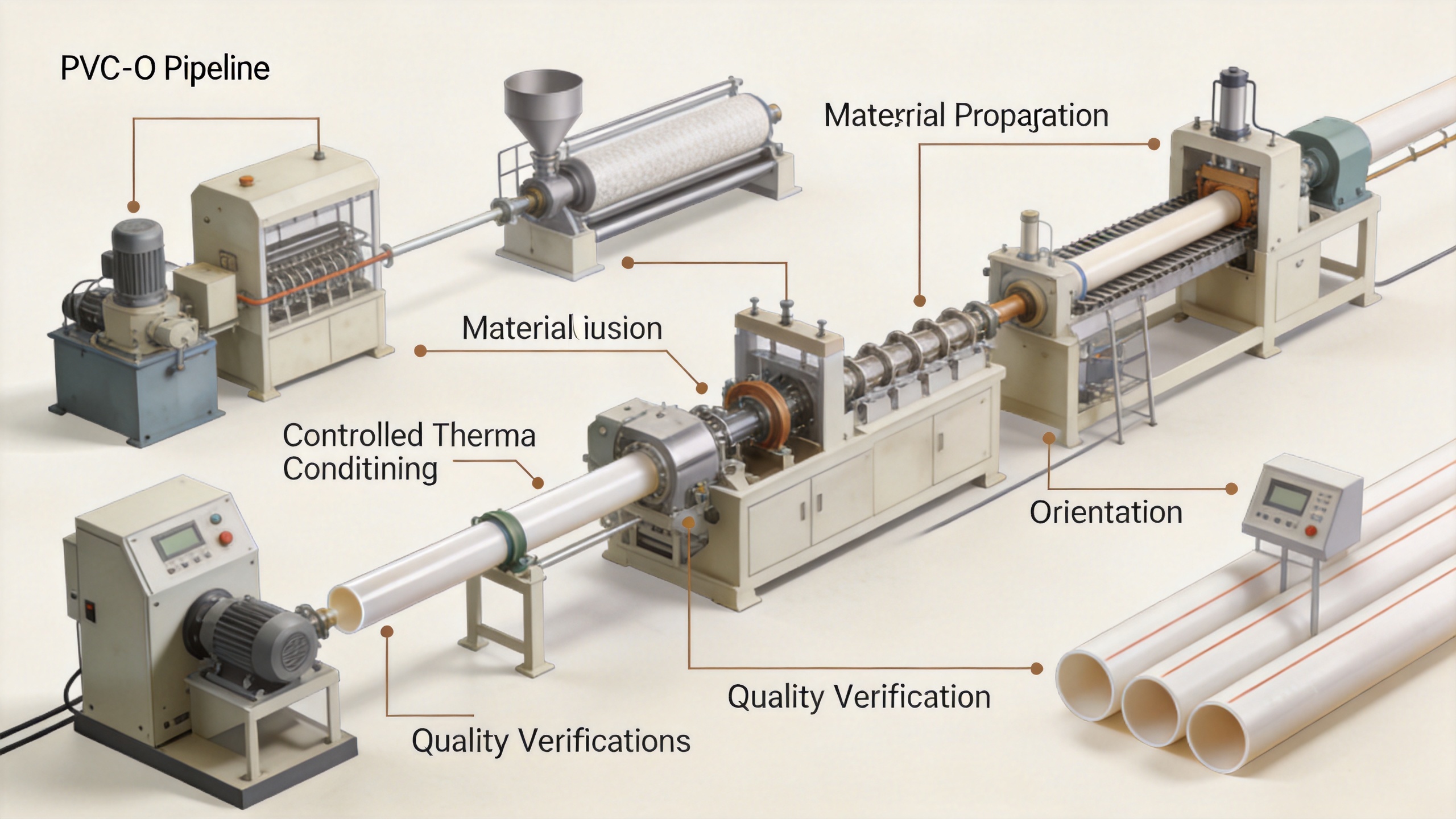
A practical pvc-o pipe production process for pipeline system map has connected stages: material preparation, melt conditioning, extrusion and die formation, controlled cooling or temperature conditioning, orientation-related processing, dimensional verification, and recording of release checks. Each handoff matters. A stable-looking extrudate alone does not demonstrate that later orientation conditions are appropriate, and a final measurement should be traceable back to the preceding operating records.
For a pvc-o pipe production process for pipeline system, the material plan should identify the approved formulation route and how lot changes are controlled. The extrusion plan should identify the required size family and the checks needed to maintain a consistent preform. The orientation plan should define the conditions that must be established and observed for the selected product scope. These are technical confirmation items, not universal setpoints.
1. Material and melt preparation
The first matching task is to connect the approved material condition with the intended pvc-o pipe production process for pipeline system. Record the incoming-material controls, handling method, and formulation-change procedure. Do not treat a generic resin statement as proof that every diameter or duty condition is covered. When material, size, or target duty changes, the team should review the process window again.
2. Forming the pre-orientation pipe
During extrusion, the pvc-o pipe production process for pipeline system must maintain a preform that is suitable for the downstream stage. Rather than judging the die or extruder alone, examine the connection between melt distribution, geometry control, cooling behavior, and the next process handoff. In this type of work, it is usually more useful to inspect process handoffs than to assign every variation to one component.
3. Aligning orientation with system duty
The orientation-related section is where a the production sequence must be tied most carefully to the intended pipeline duty. The team needs a documented relationship between the selected product range, controlled thermal condition, deformation path, dimensional checks, and validation plan. With no project test records supplied, it would be inappropriate to claim a specific pressure, impact, or material-saving result. The engineering task is to define what must be validated for the proposed system.
Use verification checkpoints instead of one-off promises
For every the line process, place review checkpoints at material release, start-up, changeover, orientation stabilization, final inspection, and batch release. A checkpoint should name the input, the person responsible, the record to review, and the response when a limit or trend needs investigation. This makes it easier to connect a field requirement to a production record later.
- Design checkpoint: Confirm diameter, pressure duty, joint concept, route conditions, and applicable specification.
- Process checkpoint: Confirm the documented material, size-specific operating plan, and handoff checks for the the process plan.
- Verification checkpoint: Confirm which dimensional, visual, and project-required checks are needed and how results are identified by batch.
- Change checkpoint: Review material, tooling, size, or process changes before treating output as equivalent to the prior scope.
Coordinate equipment, records, and acceptance criteria
A this manufacturing sequence should be discussed as a coordination problem. Procurement needs a clear scope of supply and acceptance records. Engineering needs the operating envelope and verification evidence. Production needs changeover and abnormal-condition instructions. When those groups use different assumptions, a technically capable line can still be paired with an incomplete pipeline requirement.
It helps to review a simple matrix: design input, process-stage implication, inspection evidence, and unresolved decision. This turns a broad request for a the PVC-O manufacturing route into a traceable technical conversation. It also avoids promising that one configuration is suitable for all pressure classes, diameters, or site conditions.
Questions to resolve before finalizing the match
- What medium, operating condition, and pressure scenario define the pipeline duty?
- Which diameter range, wall design, joint type, and fittings must the system accommodate?
- Which specification and acceptance tests apply to the actual market and application?
- What material controls and batch records must accompany the the proposed production route?
- Which start-up, changeover, orientation, and final-release records will demonstrate the agreed scope?
- What site or installation conditions must be considered outside the factory process?
Conclusion: match conditions, then validate the system
The sound way to match a this process route is to move from pipeline duty to controlled process stages and then to documented verification. Start with the system brief, trace each requirement through material handling, extrusion, orientation-related processing, and inspection, and keep unresolved items visible for technical confirmation. In other words, the production route should support a defined design case, while final suitability remains subject to the applicable specification, validation plan, and project records.