
 EN




At first glance, a pvc o pipe manufacturing process can look similar to conventional PVC-U pipe extrusion: compound preparation, melt processing, die forming, sizing, cooling, cutting, and inspection all still matter. The decisive difference is what happens after a suitable PVC-U pipe precursor is formed. A pvc o pipe manufacturing process adds a controlled molecular-orientation stage, while a common PVC pipe process normally takes the extrudate through sizing and cooling to its final geometry without that orientation step.
From a PVC-O extrusion process adviser’s perspective, the comparison should begin with the whole route, not a single machine specification. The material, target diameter, wall design, pressure class, production route, and validation method all affect whether an orientation stage can be used consistently. Put simply, conventional PVC production shapes the pipe; the pvc o pipe manufacturing process shapes a pipe and then manages a carefully controlled change in its molecular structure.
The shared starting point: conventional PVC pipe extrusion
A common PVC pipe process begins with a formulated PVC compound that is fed, plasticized, and conveyed through an extruder. The melt passes through a pipe die, then enters calibration and cooling equipment so the outside diameter, wall geometry, and surface finish can be stabilized. The line then performs downstream operations such as haul-off, cutting, marking, and routine dimensional checks. For many PVC-U products, this extrusion-to-cooling route is the complete manufacturing path.
These steps also remain important in a pvc o pipe manufacturing process. A poorly controlled precursor does not become reliable merely because it is oriented later. Resin preparation, melt consistency, die condition, temperature control, and initial dimensions still set the conditions for the next stage. That is why process discussions should connect the extruder, die, cooling section, and orientation equipment rather than treating them as isolated purchases.
The added stage: biaxial orientation
The defining addition in a pvc o pipe manufacturing process is biaxial orientation. Under controlled conditions, a PVC-U pipe precursor is expanded circumferentially and stretched axially. This changes the arrangement of the polymer structure in two directions. Industry descriptions commonly refer to batch and continuous routes; the equipment sequence can therefore differ by plant concept. In either route, orientation is not simply another cooling step. It is a coordinated operation involving temperature, pressure, deformation, timing, and dimensional control.
A pvco pipe manufacturing process must keep the precursor within an appropriate thermal window before and during stretching. If the condition is not stable, the intended orientation response and final geometry cannot be assumed. That is why the pvc o pipe manufacturing process needs closer coordination between upstream extrusion and downstream handling than a standard pipe line that cools directly to final size.
Stage-by-stage comparison
| Production stage | Common PVC pipe process | PVC-O route |
|---|---|---|
| Compound and melt preparation | Compound is plasticized for stable extrusion. | The same discipline is needed because precursor consistency affects orientation. |
| Die forming | The die establishes the pipe profile for final sizing. | The die forms a precursor whose dimensions must suit the orientation route. |
| Sizing and cooling | Usually brings the pipe to final dimensions and stability. | May be arranged to preserve the thermal and dimensional conditions required before orientation. |
| Orientation | Not normally included. | The pvc o pipe manufacturing process uses controlled radial and axial stretching. |
| Final stabilization and checks | Checks focus on applicable dimensions and product requirements. | Checks also need to confirm that final dimensions and the orientation route meet the relevant product requirements. |
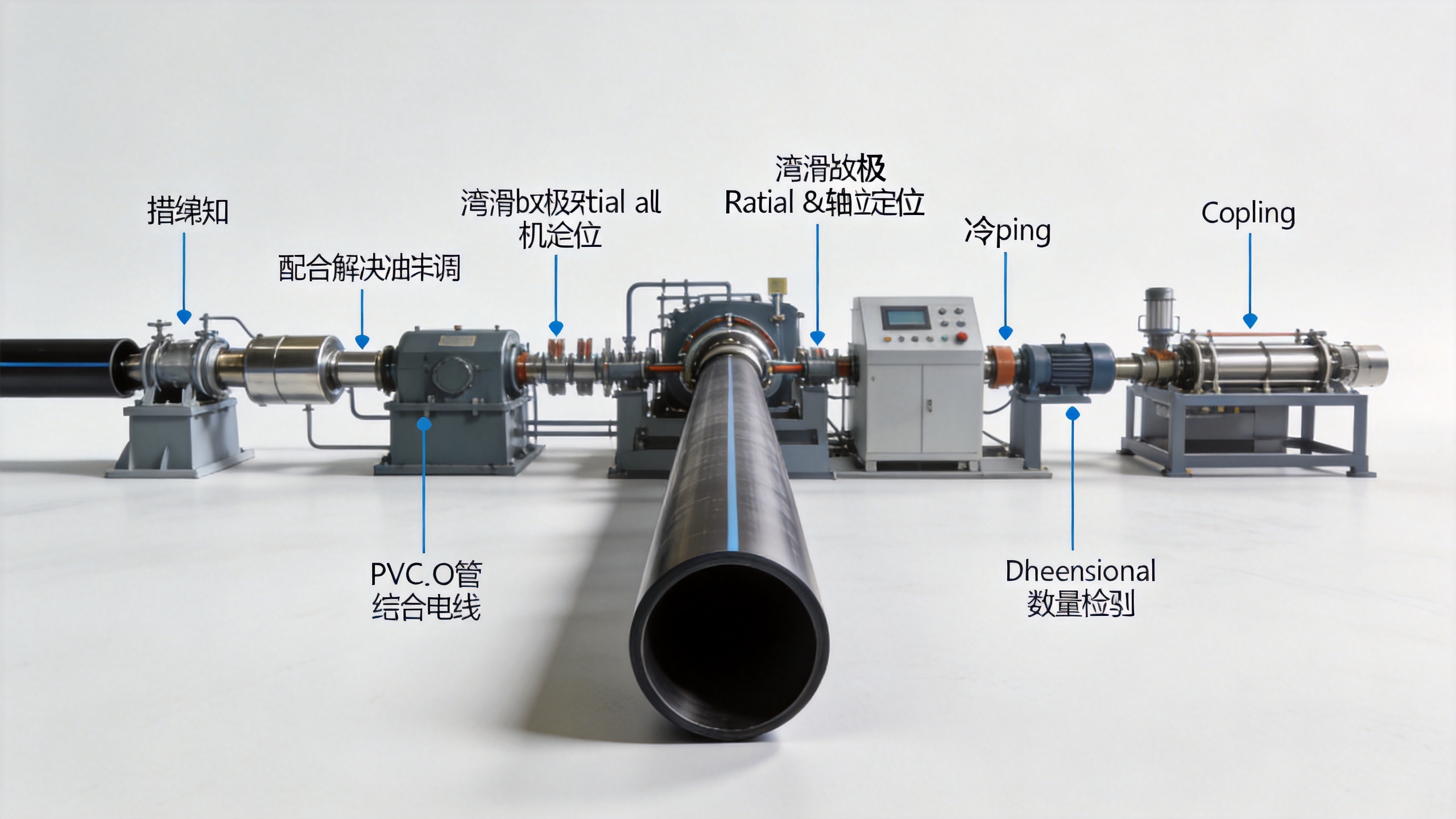
Why control strategy becomes more demanding
In a common PVC pipe process, the production team already monitors melt condition, line speed, cooling, dimensions, and surface quality. A pvc o pipe manufacturing process adds linked variables rather than replacing those fundamentals. Temperature influences how the precursor responds to deformation; pressure and expansion conditions influence radial stretching; draw or transport coordination influences axial stretching; and the timing between stages influences repeatability.
It is useful to correct one oversimplification: no single setpoint makes a PVC-O project suitable. A setting that is reasonable for one formulation, diameter, wall design, or line architecture may not transfer to another. During a pvc o pipe manufacturing process, teams should define the material input, target geometry, measurement points, operating window, and acceptance method before comparing throughput or utility figures. This makes technical discussion more useful than assuming a catalogue value tells the whole story.
What changes in quality planning
Both routes require dimensional verification and product-specific testing. With PVC-O, quality planning must also be linked to the orientation stage and the requirements relevant to the intended piping system. ISO 16422 addresses oriented unplasticized poly(vinyl chloride) piping systems, but a manufacturer should verify the applicable edition, local market requirements, pipe category, and test scope for the actual project. Mentioning a standard is not the same as demonstrating conformity.
For a pvc o pipe manufacturing process, a useful control plan connects each inspection result to the stage that can influence it. Record the incoming compound and precursor condition, orientation conditions, final dimensions, and test records under the applicable specification. When a result varies, that traceability supports a focused review of the upstream and downstream links instead of a broad adjustment across the line.
How to compare a conventional line and a PVC-O project
When evaluating a pvc o pipe manufacturing process against conventional PVC production, ask questions in this order:
- What material formulation, pipe sizes, pressure classes, and market requirements are in scope?
- Will the route use an offline, inline, or another validated orientation arrangement?
- Which precursor dimensions and temperature conditions are required before orientation?
- How are pressure, stretching, transport, cooling, and measurement coordinated?
- Which records demonstrate final-product consistency under the applicable specification?
- What commissioning trials and operator checks will be used before production release?
These questions reflect the practical difference. A common PVC line can be evaluated around stable extrusion and final sizing. A pvc o pipe manufacturing process needs that foundation plus a validated orientation system and a clear method for controlling interactions between stages.
Conclusion
The main difference is not the PVC feedstock alone; it is the added, controlled biaxial-orientation phase. Conventional production generally moves from extrusion through sizing and cooling to a finished PVC pipe. A pvc o pipe manufacturing process uses a suitable PVC-U precursor and then coordinates heating, deformation, pressure, transport, stabilization, and verification to create an oriented pipe. For a reliable project assessment, first confirm the material and product requirements, then map the full process and validate the operating conditions with documented trials and applicable testing.