
 EN




Homogeneous orientation in a PVC-O line means creating a controlled, repeatable molecular arrangement throughout the pipe wall and along the pipe length. The homogeneous orientation pvc-o pipe production process is not simply “make a PVC pipe bigger.” It is a linked sequence in which extrusion forms a suitable PVC-U preform, thermal conditioning prepares it for deformation, biaxial stretching aligns the material in two directions, and cooling helps retain the resulting structure.
From an operator and process-maintenance perspective, the important question is whether the upstream and downstream stages are working as one system. A stable-looking pipe at the exit does not by itself prove uniform orientation. The relevant conditions are the starting wall distribution, the thermal state of the preform, the deformation path, the restraint or transport conditions, and the way the pipe is stabilized after orientation.
What “homogeneous orientation” means
PVC-O is made by mechanically orienting a PVC-U preform. During the homogeneous orientation pvc-o pipe production process, polymer chains are encouraged to align in both the circumferential and longitudinal directions. Circumferential orientation develops as diameter increases; longitudinal orientation depends on how the preform is held, conveyed, or stretched during the same event. A biaxial molecular oriented PVCO pipe therefore depends on a balanced deformation history rather than one-direction expansion alone.
“Homogeneous” describes consistency, not a single fixed setting. It means that comparable parts of the wall receive comparable thermal preparation and deformation, so the pipe does not contain avoidable zones with substantially different orientation conditions. This is why a process engineer examines cross-section, lengthwise consistency, and operating records together. In this type of question, it is usually more useful to examine process interfaces than to attribute the outcome to one component.
The production sequence behind the principle
1. Produce a consistent PVC-U preform
The process begins with compounding and extrusion of a preform pipe. Melt preparation, die flow, haul-off behavior, and initial cooling all affect the dimensions and wall distribution that enter orientation. If the preform varies excessively before the orientation stage, later controls have less room to compensate. The homogeneous orientation pvc-o pipe production process therefore starts upstream: the orientation section can only work with the material and geometry it receives.
Operators should treat wall thickness trend, ovality trend, surface condition, and preform temperature history as connected records. A single catalogue parameter does not establish whole-line suitability; the conditions before and after the die must be considered together.
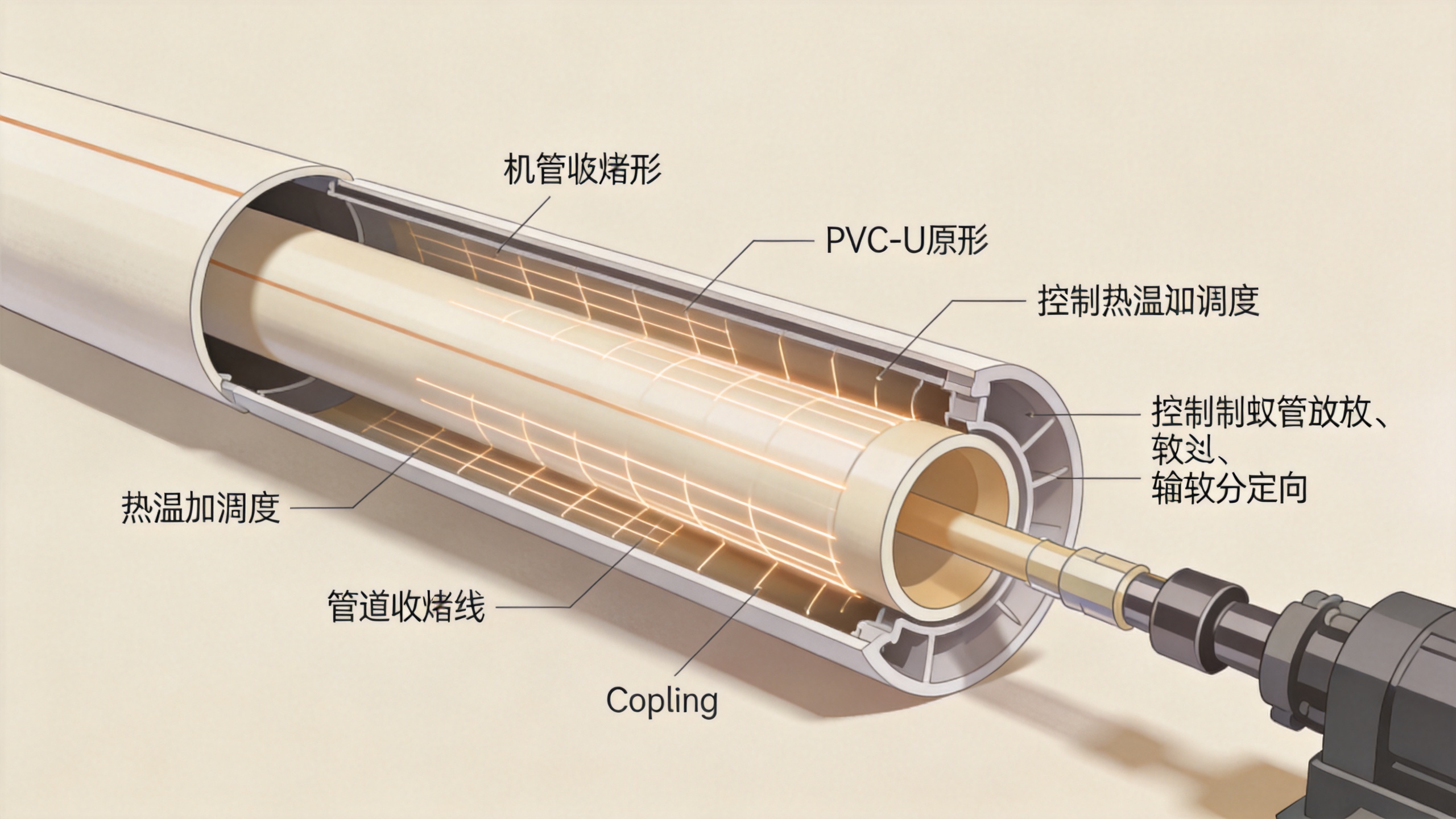
2. Bring the preform into an orientable thermal condition
Before stretching, the preform must reach an appropriate and sufficiently even thermal condition for the selected formulation and target size. The goal is not to publish one universal temperature number, because resin grade, wall thickness, line design, and target dimensions affect the usable window. Instead, temperature control should be viewed as a profile around and through the wall. If one area is cooler or hotter than another, it can respond differently when the diameter changes.
This thermal step is central to a biaxial molecular oriented PVCO pipe because polymer mobility has to be controlled before meaningful alignment can occur. Too little thermal preparation may make deformation difficult to manage; uneven preparation can produce uneven response. Site records and verified trials should determine the actual settings.
3. Apply coordinated radial and axial deformation
At the orientation stage, the preform expands radially while longitudinal movement is controlled. The process aims to create a balanced biaxial arrangement rather than allowing one direction to dominate without review. Pressure, draw or restraint conditions, orientation speed, and the geometry of the forming zone are interdependent. Changing only one of them can alter how the pipe responds.
This is the practical core of the homogeneous orientation pvc-o pipe production process. Uniformity is supported when the deformation conditions are repeatable from one section of pipe to the next and when the preform enters the zone consistently. The task is not to chase the highest expansion event; it is to maintain a controlled route from preform dimensions to the required finished geometry.
4. Stabilize the oriented structure through cooling
After orientation, controlled cooling helps stabilize the pipe before cutting and final handling. Cooling is part of the process principle, not merely the final housekeeping stage. A coordinated cooling section supports dimensional stability and gives the line a defined condition for downstream measurement. When reviewing a change, compare cooling conditions with the orientation record and the finished-pipe inspection record rather than assuming the orientation unit alone caused the result.
What operators should monitor for uniformity
A practical control plan should connect the four stages above. Useful records normally include preform dimensions, material batch and preparation conditions, temperature-zone trends, line speed, orientation-zone settings, cooling conditions, and final dimensional checks. Stability, adjustment flexibility, and record quality should be reviewed on the same sheet.
- Before orientation: confirm that wall distribution and preform dimensions are within the project’s agreed operating window.
- At thermal conditioning: review zone stability and whether the temperature profile is appropriate for the actual formulation and wall thickness.
- During deformation: trend pressure, transport or restraint behavior, line speed, and any signals that show an unstable deformation path.
- After cooling: compare dimensional and visual inspection results with the process record, including trends along the pipe length.
A common troubleshooting mistake is to react to a downstream measurement by changing a single upstream setpoint without checking the interfaces. If a variation appears, start with the preform condition, then the thermal state, then the deformation and cooling sequence. This approach creates evidence for adjustment instead of relying on a one-factor explanation.
How quality verification fits the principle
Production verification should be defined against the application, the project specification, and the applicable standard framework. ISO 16422 is one recognized requirements framework for oriented unplasticized PVC pipes and joints used in pressure-water piping systems. Mentioning a standard does not establish compliance for a particular pipe; test methods, dimensions, grade, and acceptance criteria still need to be confirmed for the project.
For process discussions, the more useful point is that quality checks close the loop. Finished-pipe measurements and documented test results can show whether a controlled process change is associated with the intended outcome. When further evaluation is needed, the material conditions, target specification, and existing line records should be supplied before drawing a conclusion.
A concise working principle
The homogeneous orientation pvc-o pipe production process principle is coordinated biaxial deformation of a thermally prepared PVC-U preform, followed by stabilization and verification. Its success depends on consistency across extrusion, preform condition, heating, radial and longitudinal orientation, cooling, and inspection. Treating those stages as one controlled chain gives production teams a clearer way to investigate variation and discuss a biaxial molecular oriented PVCO pipe without making unverified claims about a specific line or project.