
 EN




A continuous pvco pipe manufacturing process is not supported by the extruder alone. Material preparation, downstream cooling, traction, measurement, cutting, and handling equipment all have to exchange a stable pipe and a stable operating signal. From an operator and process-maintenance perspective, the useful question is not which standalone unit looks most impressive. It is whether each auxiliary unit has the capacity, controls, access, and records needed for the intended pipe sizes and the orientation-related operating window.
In a continuous pvco pipe manufacturing process, upstream melt condition and downstream movement are linked. A change in cooling response, haul-off behavior, or cut timing can show up elsewhere as dimensional variation or an interrupted run. That is why auxiliary equipment should be specified as a coordinated system, with its interfaces checked before commissioning.
Start with material handling and process utilities
Material conveying, storage, dosing, mixing support, and drying or conditioning equipment create the first stable handoff in a continuous pvco pipe manufacturing process. The exact treatment depends on the compound and the production recipe, so it should be verified with the material supplier and the process team rather than assumed from a general line layout.
Useful auxiliary provisions include sealed conveying routes where appropriate, level indication, controlled feed continuity, dust-management arrangements, and a practical way to isolate or clean a batch change. Their role is simple: help the extruder receive material consistently. If a line stops because a hopper runs low or a feed bridge is not noticed early, downstream equipment cannot restore continuity.
Utilities matter as well. Cooling-water supply and return, filtration, flow monitoring, electrical distribution, compressed air where required, and drainage should be reviewed as part of the continuous pvco pipe manufacturing process. Capacity figures should come from the final equipment configuration and local conditions. It is safer to define measurement points and alarm responsibilities than to rely on nominal utility assumptions.
Calibration and cooling equipment
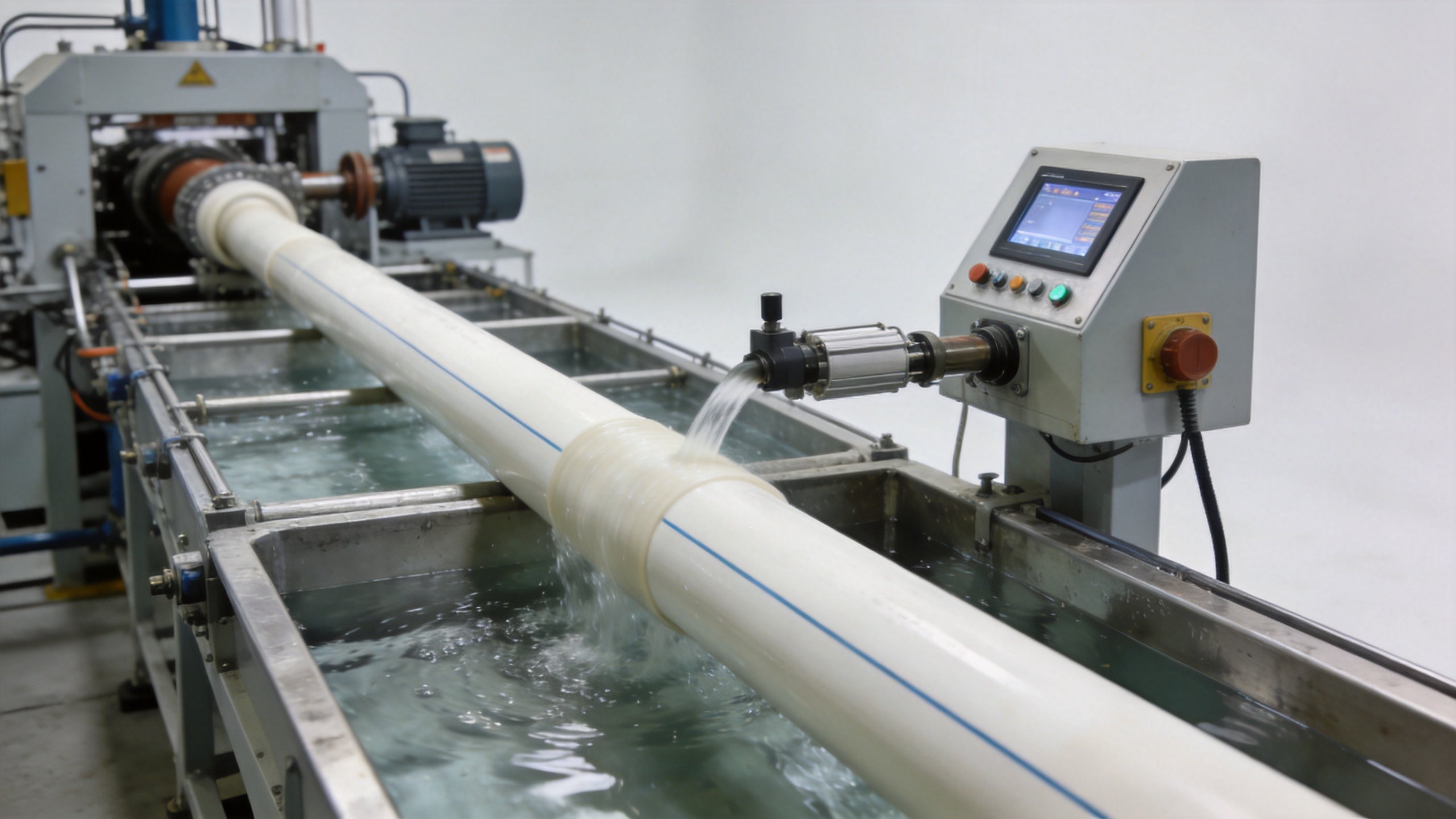
After pipe formation, sizing and cooling equipment support geometry and thermal management. A vacuum sizing or calibration tank may be used where accurate calibration and controlled cooling are required. In a continuous pvco pipe manufacturing process, its value comes from repeatable operating conditions and a compatible handoff to the next section, not from vacuum or water settings considered in isolation.
Cooling tanks, spray sections, water recirculation hardware, temperature indication, filtration, and drainage form the downstream thermal system. The configuration should allow operators to observe flow, temperature trend, water cleanliness, and accessible maintenance points. When a dimensional or surface issue appears, a record of time, material batch, line speed, water condition, and adjacent equipment state is more useful than an immediate single-component conclusion.
For a continuous pvc-o production line, check tank length, support alignment, pipe guidance, and the transition into traction against the selected diameter range. These are project checks, not universal settings. The acceptance plan should state which dimensions, visual conditions, and operating records are reviewed during trial production.
Haul-off and synchronization equipment
The haul-off provides controlled downstream movement. In a continuous pvco pipe manufacturing process, it must work with the process sequence rather than pull independently of it. Contact method, usable speed range, control resolution, pipe support, and access for cleaning all deserve review.
Traction is often discussed as a force question, but coordination is just as important. The controller should provide a clear relationship between downstream speed and the relevant upstream process signals. Before declaring a setting suitable, the team should confirm the pipe size, wall design, compound condition, cooling state, and the intended production sequence. A stable reading at one condition does not automatically transfer to another size.
Auxiliary guides, non-contact support where suitable, and anti-slip arrangements can help the haul-off handover. Their purpose in a continuous pvco pipe manufacturing process is to keep pipe movement controlled without introducing unnecessary local stress or marking. During trials, record adjustments by operator, time, and observed response so troubleshooting does not become guesswork.
Online measurement, marking, and inspection
Online measurement equipment gives the production team a way to see change while the pipe is still moving through a continuous pvco pipe manufacturing process. Depending on the project, this can include diameter monitoring, wall-related measurement, length counting, surface observation, or other agreed quality checks. The right package depends on the product specification and acceptance method.
The critical point is not adding every available sensor. It is agreeing what each signal means, where it is displayed, who responds to a deviation, and how the record is retained. Measurement devices require defined reference checks; otherwise, a displayed value may create false confidence. Keep calibration responsibility, alarm limits, and reaction steps in the operating documentation.
Marking equipment and code management support traceability when the product and customer requirements call for them. In a continuous pvco pipe manufacturing process, marking location and timing should be coordinated with the pipe surface condition and line movement. Sample checks should cover legibility, placement, and traceability data without claiming that a marking device alone verifies product compliance.
Cutting, collection, and material movement
A cutting unit, length-control signal, run-out table, collection station, and transfer equipment complete the physical flow after the downstream process. These auxiliaries support a continuous pvco pipe manufacturing process by avoiding a bottleneck at the line exit. Cut quality, timing, clamping method, chip or debris handling, and safe access should be agreed for the pipe dimensions being produced.
Collection equipment must match the handling route after cutting. If pipe movement into storage is not considered, operators may have to intervene too often, increasing interruptions and damaging the continuity that the rest of the line is designed to maintain. The handoff between cutter, table, and downstream handling is therefore an equipment handoff point, not merely a logistics detail.
Controls, safety, and maintenance support
The control system connects the auxiliary units into a usable continuous pvco pipe manufacturing process. It should present operating status, alarms, interlocks, and trend information in a way the team can act on. Emergency functions, guarding, access controls, and restart procedures must be designed and reviewed for the installed line, local requirements, and risk assessment; they should not be copied from a generic checklist.
Maintenance provisions are also auxiliary support: isolation points, drain locations, service access, spare-part identification, lubrication points where applicable, and a fault-history routine. A practical review asks whether a technician can inspect each unit without disturbing unrelated settings. This is particularly relevant when a continuous pvco pipe manufacturing process is expected to run for extended campaigns.
A procurement and commissioning checklist
- Define pipe sizes, material conditions, output target, and product acceptance method before choosing auxiliary capacity.
- Map every handoff: material feed to extrusion, sizing to cooling, cooling to traction, traction to cutting, and cutting to collection.
- Specify the signals to trend, the alarm ownership, and the records retained during trials.
- Review utility connections, maintenance access, safety functions, and cleaning routes with the installed layout.
- Use agreed trial records to decide whether the continuous pvco pipe manufacturing process is ready for routine operation.
Conclusion
The auxiliary equipment that supports a continuous pvco pipe manufacturing process includes material-handling and utility systems, calibration and cooling equipment, haul-off and guidance, online measurement and marking, cutting and collection, plus controls and maintenance provisions. Their common job is to make each process handoff observable and manageable. If you are comparing a continuous pvc-o production line, begin with the intended pipe range and acceptance records, then verify how the auxiliary equipment coordinates with the complete process.