
 EN




A low energy PVC-O pipe production process is not created by choosing one efficient machine and assuming the rest of the line will follow. It is created by matching material preparation, extrusion, temperature control, orientation, cooling, and handling as one operating system. From an energy-and-scrap accounting perspective, the better question is not simply “Which drive uses fewer kilowatts?” Ask how many kilowatt-hours are required for each kilogram of accepted PVC-O pipe at the intended diameter, wall design, output, and quality level.
That distinction matters because a line can show a modest instantaneous load while losing energy through unstable starts, excess heating, scrap, or long recovery periods. An energy saving PVC-O extruder can be an important part of the answer, but its contribution must be assessed alongside the die, downstream thermal stages, orientation controls, and the production record.
Start With a Measurement Boundary, Not an Energy Claim
The first design decision is the measurement method. Specific energy consumption is commonly tracked as Wh/kg or kWh/kg. For a meaningful comparison, record the energy used by the agreed production boundary and divide it by the mass of pipe that passes the defined quality checks. Include the main extrusion drive, barrel and die heating where applicable, cooling equipment, orientation-related heating or air systems, haul-off, cutting, and auxiliary equipment that serves the line.
Then state the boundary beside every comparison: resin formulation, pipe diameter, pressure class, line speed, ambient conditions, start-up and changeover treatment, and rejected material. Without those conditions, a low figure may describe a different job rather than a better process. That is especially relevant in PVC-O production, where the preliminary pipe and the orientation stage need a compatible process window.
Design the Extrusion Section for Stable Melt Delivery
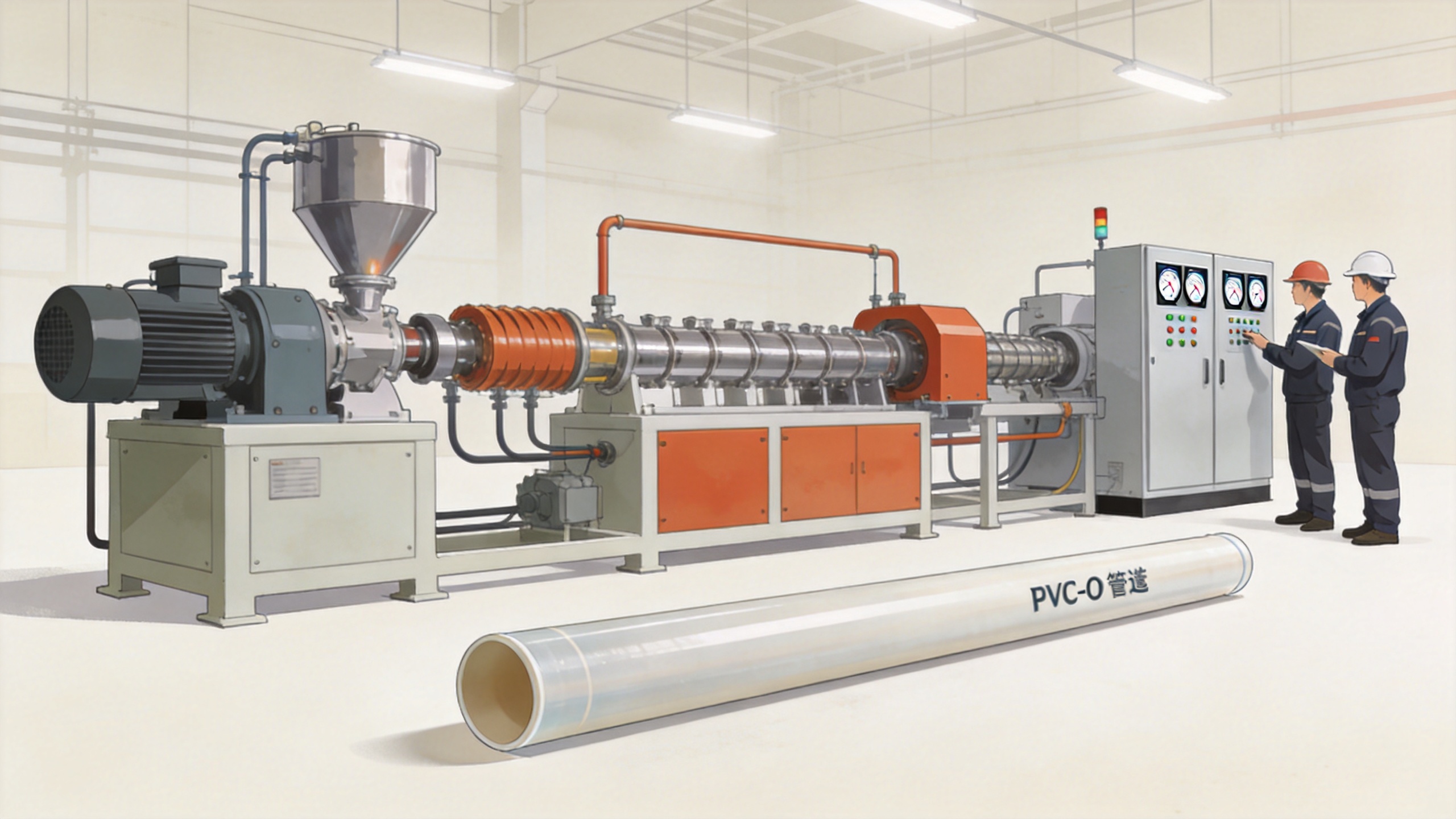
Extrusion is the first major opportunity to avoid wasted energy. The objective is stable, homogeneous melt delivery at a temperature profile appropriate for the compound and downstream orientation requirement. Oversized drive capacity, excessive shear, or wide temperature swings can add heat that later stages must manage. Conversely, an under-matched screw, barrel, or drive arrangement can produce output variation that forces operators to slow the line or correct defects downstream.
When assessing an energy saving PVC-O extruder, review the screw and barrel arrangement, feeding consistency, drive control range, heater zoning, insulation condition, and melt-pressure stability together. A variable-frequency drive may help match motor output to the actual load, but it does not compensate for poor feeding, worn components, or an unsuitable temperature profile. The operating record should show whether changes reduce kWh/kg while accepted output remains stable.
- Use controlled dosing and consistent raw-material preparation to reduce load fluctuation.
- Set barrel and die zones as a coordinated profile rather than independent maximum settings.
- Trend melt pressure, melt temperature, motor load, and throughput before changing setpoints.
- Separate start-up scrap and transition scrap from steady-state production in the energy review.
Match Die Design and Preliminary Pipe Geometry to Orientation
PVC-O pipe production relies on molecular orientation, so the preliminary pipe is not merely an intermediate product. Its wall distribution, temperature history, and dimensional consistency affect how reliably the material can be oriented downstream. Industry descriptions of PVC-O manufacture commonly distinguish a preliminary-pipe stage from a reheating and orientation stage; this supports the practical rule that the upstream die and extrusion settings must be designed with the downstream forming condition in mind.
A die that produces uneven wall distribution can create correction work, reduced process latitude, or rejected pipe. Rather than raising heater settings to chase a local symptom, teams should confirm melt distribution, die-centering condition, tooling cleanliness, and the relationship between extrusion output and downstream draw. This linked review reduces the chance of solving a thermal problem by adding more thermal load.
Control the Thermal Window Before and During Orientation
Orientation is sensitive to temperature uniformity. If the pipe is too cold, the required forming action may become unstable; if it is too hot, dimensional control and material behavior may move outside the intended window. The energy objective is therefore not minimum heating at any cost. It is repeatable heating only where and when the pipe needs it, with minimal heat loss and minimal recovery after disturbances.
Good design practices include zoned temperature measurement, insulation of relevant thermal sections, synchronized line-speed control, and a clear procedure for pauses and restarts. Sensors should be placed where they help distinguish a material-temperature issue from a surface-temperature reading. Where air, water, or other utilities are used, measure the relevant flow or duty rather than assuming the nominal equipment rating represents actual energy use.
Use Cooling and Haul-Off as Process Controls, Not Separate Utilities
Cooling, haul-off, and cutting consume energy, but they also determine whether the line maintains the geometry achieved upstream. Excess cooling duty can be a response to unnecessary thermal input; insufficient or poorly balanced cooling can cause instability that creates scrap. The correct design discussion links cooling capacity, water temperature, flow management, haul-off traction, and line speed to the accepted-pipe result.
For a low energy PVC-O pipe production process, log the events that change energy intensity: start-up, a speed adjustment, a diameter change, a temperature correction, a quality hold, and a restart. This is more useful than looking only at a daily electricity total. It helps production and engineering teams identify whether the main opportunity is a motor setting, a thermal loss, a changeover procedure, or a mismatch between adjacent process stages.
Reduce Energy Lost Through Scrap and Recovery
Energy is embedded in every kilogram of material that does not become accepted pipe. That is why low scrap and low energy should be reviewed together. A narrow process window may appear efficient during a short steady run yet consume more energy per accepted kilogram when the line experiences normal changes in material lot, ambient conditions, or size. A more useful design approach is to define a workable window, identify what moves it, and specify the first checks for operators.
A practical review can classify losses into start-up, transition, off-spec dimensions, surface defects, orientation instability, and cutting or handling losses. Pair each category with its likely process inputs and measurement points. The result is a priority list rather than a blanket promise: first stabilize the condition creating the most rejected mass or the longest recovery time, then reassess the kWh/kg trend.
A Commissioning Checklist for a Low-Energy Line
- Define the accepted-pipe specification and the kWh/kg measurement boundary.
- Record material formulation, target pipe size, output, speed, and ambient conditions.
- Trend motor load, melt pressure, temperatures, utility demand, and scrap by event.
- Verify that die output, preliminary-pipe geometry, and orientation conditions are compatible.
- Test one change at a time and compare accepted output, quality observations, scrap, and kWh/kg.
- Document restart and changeover settings so temporary corrections do not become permanent high-energy settings.
Conclusion
The design that can realize a low energy PVC-O pipe production process is a coordinated design, not a single-component purchase. Stable extrusion, a die matched to the preliminary pipe, controlled thermal conditioning, synchronized orientation and cooling, and honest kWh/kg records all matter. For a project review, prepare the pipe range, compound information, target output, available utilities, quality criteria, and current loss records first. Those inputs make it possible to evaluate an energy saving PVC-O extruder and the rest of the line on the same practical basis.