
 EN




In a pvc-o pipe production process for biaxial stretching, heating is not simply the step that makes a PVC preform softer. It establishes the temperature condition in which the pipe can be expanded circumferentially and stretched axially with control. If the wall is too cold, the material may resist deformation and the orientation response can be uneven. If it is too hot, the pipe can lose the stable shape and stress response needed for repeatable stretching. The practical objective is a uniform, validated orientation window, not a temperature number copied from another line.
From a PVC-O extrusion-process perspective, the useful question is: Has the whole preform reached a sufficiently even temperature for the planned stretch ratio, speed, and pipe geometry? That question connects resin behavior, extrusion history, wall thickness, oven or conditioning-zone design, and cooling. It is more reliable than treating one heater setpoint as the answer.
Why the Heating Stage Controls Biaxial Orientation
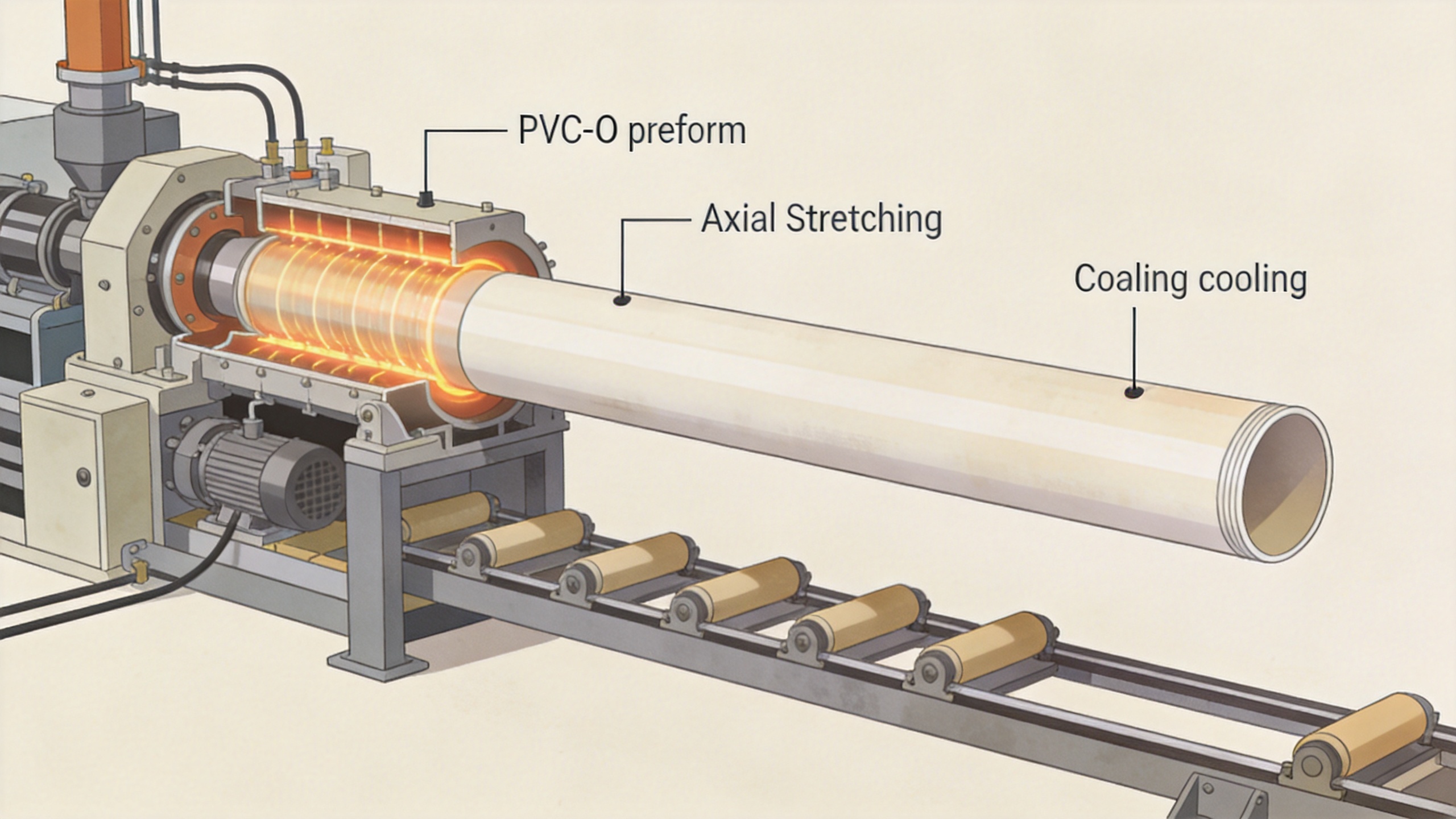
PVC-O is made by orienting a PVC pipe in the hoop and axial directions. The two-direction stretch reorganizes the molecular structure while the material is in a controlled thermo-mechanical state. Heating therefore has two jobs: bring the preform into the workable range and reduce temperature differences through the wall and around the circumference before deformation starts.
Published descriptions often relate preform heating to the material’s Vicat-softening behavior. One public manufacturing reference describes homogenizing the preform temperature toward its Vicat temperature before orientation. Another published industry explanation gives an illustrative heating range of about 85–100°C. Those references are helpful as process context, not as a universal recipe. Compound formulation, stabilizer package, pipe diameter, wall thickness, prior melt history, conditioning method, and the actual orientation equipment all affect the window that should be qualified.
In other words, a pvc-o pipe production process for biaxial stretching needs to control the pipe’s material temperature, not merely the displayed temperature of an oven, heater, or hot-air stream.
Core Heating Requirements to Define Before Stretching
1. A validated material-temperature window
Setpoints should be developed from the PVC formulation and the intended orientation method, then confirmed at the preform. The working window must allow controlled deformation without moving into a condition where the tube sags, localizes strain, or becomes difficult to handle. It is sensible to document the acceptable preheat condition as a range with an approved measurement method, not just as a single nominal setting.
For the pvco pipe manufacturing process for biaxial stretching, this range should also be tied to the intended pipe dimensions and stretch program. A condition that works on one wall thickness may not provide equivalent through-wall temperature on another. When a formulation, size, or line speed changes, requalification is usually more useful than assuming the existing settings will transfer unchanged.
2. Through-wall temperature uniformity
A pipe wall can look ready on the outside while its inner region remains at a different temperature. That gradient matters because orientation occurs across the full wall. If the outer and inner zones respond differently, the stretch may become less uniform and the subsequent cooling stage has to stabilize a less consistent state.
Heating time must therefore be adequate for equilibration, particularly on thicker preforms. The answer is not automatically a longer dwell: excess exposure can create its own handling and process-control issues. A practical validation plan checks representative locations and repeats the exercise after changes in wall thickness, oven loading, circulation pattern, or line speed.
3. Circumferential and axial consistency
Uniformity is not only radial. Uneven airflow, heater zoning, rotation conditions, or heat loss at the pipe ends can create hot and cool regions around or along the preform. During hoop expansion and axial draw, those regions can react differently. The result may appear as local variation in deformation, geometry, or stability rather than an obvious heating fault.
When an operating shift is observed, record the preform position, material batch, conditioning time, measured temperatures where available, and the adjacent extrusion and stretch conditions. This makes it easier to separate a true heating imbalance from a die, haul-off, or synchronization issue. A die head is important, but it is not the only factor that determines an oriented pipe result.
4. A controlled handoff into the orientation zone
The preform should enter the biaxial-stretching stage without an uncontrolled temperature drop or excessive delay. The transfer distance, ambient conditions, contact points, and equipment timing can all change the thermal state between heating and expansion. For that reason, the heating recipe should include the handoff time and permitted variation, not only the conditioning-zone settings.
In a pvc-o pipe production process for biaxial stretching, axial and hoop stretching should be synchronized with this conditioned state. If the process changes one stretch direction or speed, review the thermal handoff at the same time; the temperature requirement and stretch program are linked.
How to Build a Heating Validation Plan
Rather than beginning with a promise about a fixed temperature, establish a repeatable verification route:
- Define the inputs. Record PVC formulation, preform outer diameter, wall thickness, extrusion condition, target finished size, and the planned axial and hoop stretch sequence.
- Map the heating system. Identify zones, sensing points, air circulation, heating medium, residence time, and transfer distance to orientation.
- Measure representative preforms. Verify circumferential, axial, and through-wall consistency using a method suitable for the line and material. Keep the measurement method consistent across trials.
- Run controlled orientation trials. Compare observed process stability and quality checks against the measured preheat condition. Change one meaningful variable at a time where practical.
- Lock the approved process window. Specify normal ranges, warning limits, required records, and the trigger for revalidation after material, dimension, or equipment changes.
This approach is especially valuable when the production team is comparing a new size range or a modified line configuration. Higher heating capacity does not automatically mean a better match; the relevant issue is whether the system can establish and hold a uniform, usable pipe temperature under the required throughput.
Heating and Cooling Must Be Treated as One Control Loop
Cooling fixes the oriented state after stretching, so it belongs in the heating discussion. A preform temperature that appears suitable at the start can still lead to inconsistent results if the orientation and cooling sequence is not synchronized. Conversely, rapid cooling cannot correct a temperature gradient that already caused uneven deformation.
Review the thermal path as a loop: extrusion produces the preform, conditioning creates a stable orientation window, biaxial stretching applies the deformation, and cooling stabilizes the result. When the line shows variation, check the upstream and downstream stages together instead of assigning the cause to one temperature controller.
Common Heating Mistakes to Avoid
- Copying a published range as a machine setpoint. An 85–100°C reference may be a useful starting context, but it does not replace trials for the actual PVC compound and geometry.
- Using surface condition as the only confirmation. A uniform-looking exterior does not demonstrate uniform temperature through the wall.
- Ignoring transfer time. The interval between heating and expansion can alter the preform state, especially where ambient exposure or contact cooling is significant.
- Adjusting heat without recording the accompanying process conditions. Material batch, dwell, stretch timing, and cooling conditions are needed to interpret an observed change.
- Attributing every variation to the heater. Use the process sequence to check extrusion, die, transport, orientation, and cooling interfaces before reaching a conclusion.
Questions to Send to a PVC-O Line Supplier or Process Team
Before finalizing a heating arrangement for the pvco pipe manufacturing process for biaxial stretching, ask for a condition-based discussion:
- Which PVC formulations and pipe dimensions define the proposed heating window?
- How is temperature uniformity checked through the wall, around the circumference, and along the preform?
- What residence-time range is available, and how does it change with wall thickness and output?
- How is the transition from conditioning to axial and hoop orientation controlled?
- Which records demonstrate repeatability during commissioning and after a size or compound change?
- How are heating zones, stretch timing, and cooling conditions reviewed together when variation occurs?
Conclusion
The heating requirement for a pvc-o pipe production process for biaxial stretching is a controlled and uniform material-temperature condition that matches the PVC formulation, preform geometry, orientation sequence, and cooling plan. Published figures can provide a starting point, but they should be treated as boundaries to investigate rather than fixed instructions. The strongest process documentation defines how temperature is measured, how uniformity is confirmed, how long the condition is maintained, and when the recipe must be revalidated.
A useful PVC-O heating program makes the condition observable, connects it to the full production sequence, and confirms it with the actual material and dimensions being produced.