
 EN




What Formula Adaptability Does a Twin Screw PVC-O Pipe Production Line Have?
A twin screw PVC-O pipe production line is not judged by whether it can accept every PVC compound without adjustment. Its useful formula adaptability is the ability to process an agreed PVC-U compound consistently, then provide a stable starting condition for the orientation stage that creates PVC-O pipe. For a project engineer, the practical question is: which compound changes can the extrusion section accommodate while melt quality, pipe geometry, and downstream orientation conditions remain controllable?
The answer depends on the entire process, not on the twin-screw extruder alone. Resin characteristics, stabilizer and processing-aid package, filler level, pigment system, moisture control, die design, cooling, haul-off, and orientation settings all interact. A twin screw PVC-O pipe production line should therefore be specified around a validated formulation window and a commissioning plan rather than a broad claim of formula compatibility.
Why Formula Adaptability Matters in PVC-O Production
PVC-O begins as an extruded PVC-U pipe. During controlled biaxial orientation, the polymer structure is rearranged to produce the final pipe properties. This makes incoming melt consistency important: variation that might be manageable in conventional PVC pipe extrusion can affect wall distribution, orientation response, surface appearance, or process stability further downstream.
For pressure-water applications, the production target must also align with the applicable project specification. ISO 16422 addresses oriented unplasticized PVC pipe systems, while ISO 16422-1:2024 covers general characteristics for pressure water conveyance. These standards are not recipes for a compound; they underline why the compound, process settings, testing plan, and finished-pipe requirements need to be considered together.
What a Twin-Screw Extruder Can Adapt To
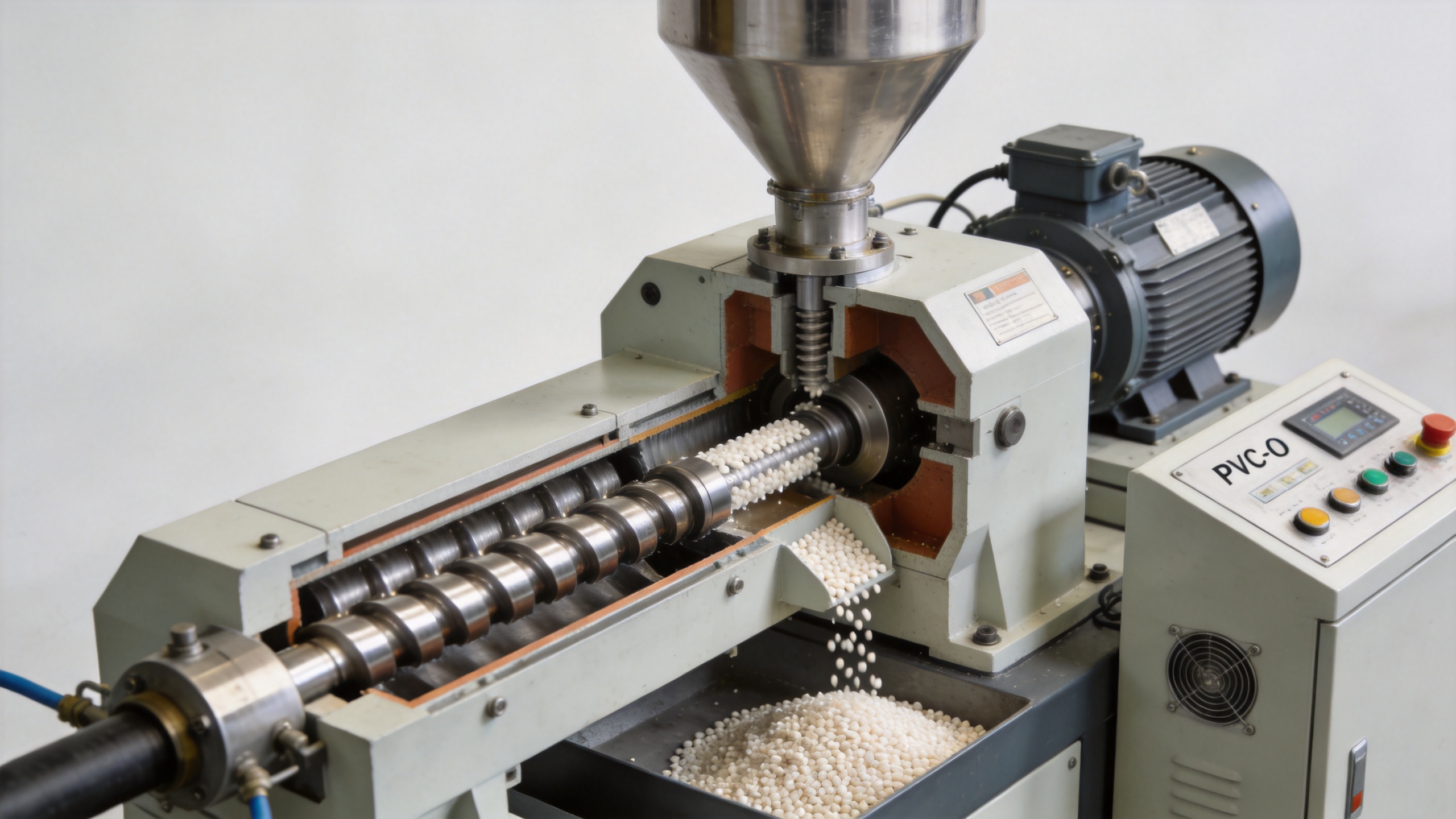
In a twin screw PVC-O pipe production line, the twin-screw section is responsible for controlled conveying, mixing, plastification, and pressure development before the melt reaches the die. Adaptability usually comes from the way the line can be commissioned around a known compound, including adjustments to screw speed, barrel-zone temperatures, feed rate, vacuum and venting practice where applicable, head pressure, melt temperature, and downstream draw conditions.
A qualified process team normally reviews changes in these areas before treating a formula as suitable:
- PVC resin behavior: resin grade and particle characteristics influence fusion behavior and melt response.
- Stabilizer and lubricant balance: a change may alter fusion timing, torque demand, plate-out tendency, or surface quality.
- Processing aids and impact modifiers: these may shift melt strength and the usable processing window.
- Calcium carbonate or other fillers: loading and particle treatment can affect rheology, dispersion, surface finish, and orientation response.
- Pigments and recycled-content policy: any addition should be evaluated against the customer specification and the intended PVC-O performance route.
The key point is that a twin screw PVC-O pipe production line may offer adjustment range, but adjustment range is not proof that a new formulation will produce conforming PVC-O pipe. Validation remains necessary.
Extrusion Adaptability Is Not the Same as Orientation Adaptability
This distinction avoids costly misunderstandings. A compound can run through a twin-screw PVC extruder with stable pressure and an acceptable surface, yet still require different heating, stretching, cooling, or sizing conditions in the orientation section. Conversely, an orientation target may expose variation that is not obvious at the extruder outlet.
Ask the line supplier to map formula changes against two separate checks. The first is extrusion stability: torque trend, melt temperature, pressure, output stability, pipe dimensions, and visual quality. The second is orientation suitability: controlled response through the relevant heating and stretching sequence, followed by dimensional and finished-pipe testing required by the project. Treating both checks as one prevents a trial from being accepted too early.
A Practical Formula-Adaptability Checklist
Before ordering or commissioning a twin screw PVC-O pipe production line, prepare a short compound dossier and use it during technical discussions:
- Define the product range. State the intended diameter, pressure class, wall design, and applicable standards for each pipe family.
- Document the baseline compound. Identify resin, stabilizer system, lubricants, processing aids, pigments, fillers, and permitted tolerances. Use supplier documentation rather than informal material names.
- Separate approved changes from trial changes. A color change and a shift in filler loading should not automatically follow the same approval route.
- Agree the measurement plan. Include dimensional checks and the process signals that will be trended during start-up; add finished-pipe tests required by the specification.
- Plan changeover discipline. Define cleaning, purge, temperature reset, first-off inspection, and release criteria when moving between approved formulas.
- Record the usable window. After trials, retain the settings, observed indicators, and material lot data. This creates a repeatable operating reference rather than relying on memory.
Questions to Ask About a Twin Screw PVC-O Pipe Extrusion Machine
When evaluating a twin screw PVC-O pipe extrusion machine, ask for evidence of how the supplier approaches process development, not merely a statement that the equipment is flexible. Useful questions include:
- Which process settings are intended to be adjusted for the proposed baseline compound?
- What information about resin, additives, filler level, and color package is needed before a trial?
- Which melt, pressure, dimensional, and orientation-stage signals are monitored during commissioning?
- How will the line be set up for the requested diameter range and water-pipe specification?
- What are the agreed acceptance tests after a formula or supplier change?
Clear answers make it easier to distinguish mechanical flexibility from a documented process-development method. They also help purchasing teams compare proposals without assuming that two lines have the same scope of validation support.
How BECHTON Frames the Discussion
BECHTON supplies turnkey PVC-O pipe production lines for water-infrastructure projects in the 110–630 mm size range. For this type of project, the productive starting point is a technical review of the intended pipe range, compound dossier, and test requirements. The line configuration can then be discussed around the customer’s approved material system and operating targets.
That approach is particularly relevant when a plant expects more than one approved formulation. Instead of treating every compound as interchangeable, the commissioning team can establish a reference condition for each approved family, define allowable adjustments, and document the checks needed before production release.
Conclusion: Define the Window, Then Validate It
A twin screw PVC-O pipe production line can be adaptable when its extrusion controls and downstream process are commissioned for a clearly defined compound window. The strongest purchasing decision is not based on a universal formula claim. It is based on a documented baseline formulation, a transparent trial plan, monitored process signals, and finished-pipe verification against the relevant specification.
For a new PVC-O project, share the target diameters, pressure requirements, compound details, and applicable standard at the enquiry stage. This gives the equipment team the information needed to discuss a practical production route and a realistic validation plan.