
 EN




How Servo Controlled PVC-O Pipe Production Line Improve Speed Stability
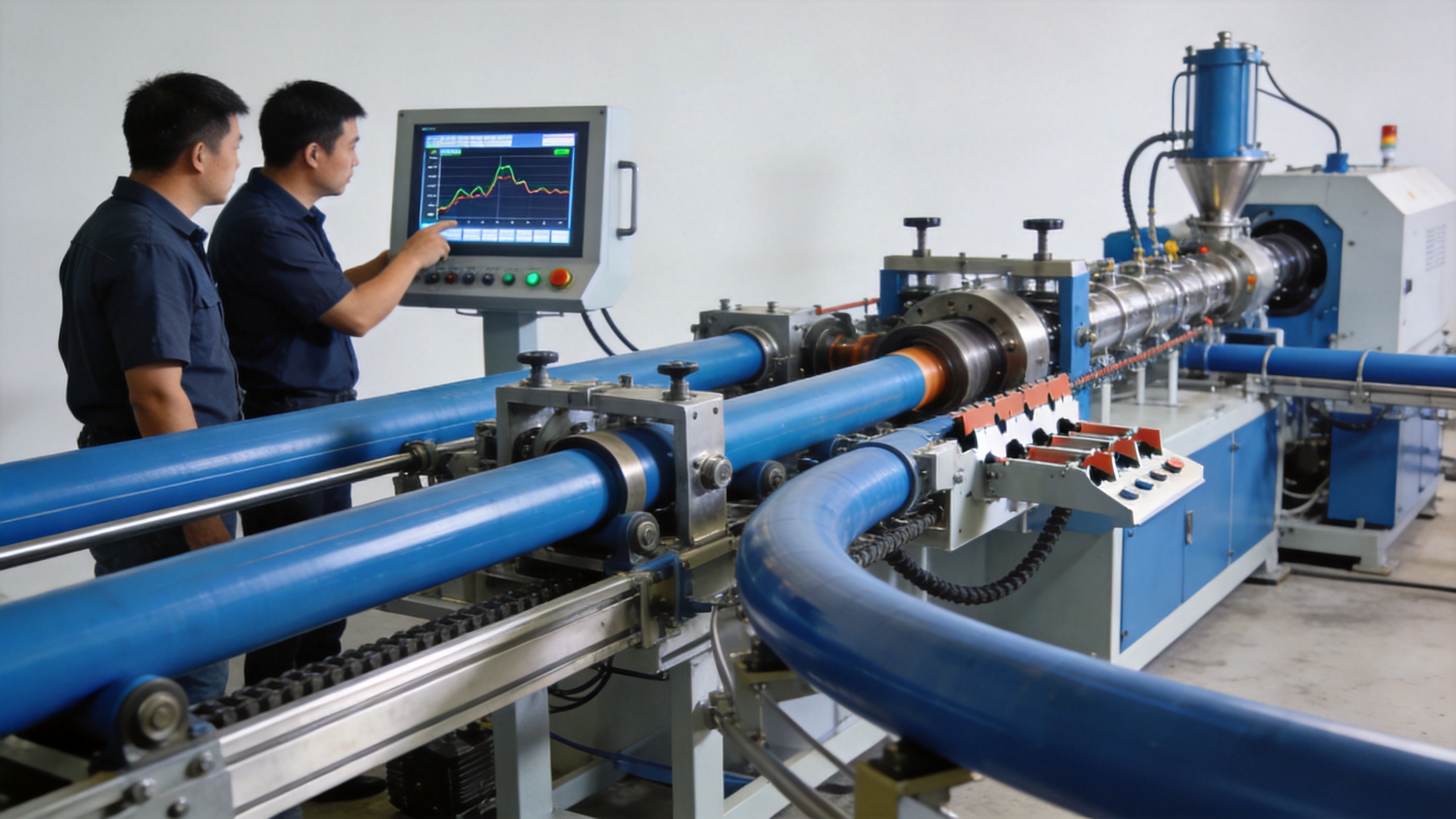
For a PVC-O producer, a faster setpoint is not automatically a more productive day. A more useful question is whether the line can hold a repeatable operating window while the pipe passes from melt preparation through forming, orientation, cooling, haul-off, and cutting. A servo controlled PVC-O pipe production line helps by coordinating motion-driven sections so that changes made in one zone do not arrive at the next zone as an uncontrolled disturbance.
From an operator and process-maintenance perspective, the value is practical: stable running makes changeovers, troubleshooting, and quality review easier to manage. It does not remove the need to confirm resin behavior, pipe diameter, wall design, temperature profile, and downstream settings. Instead, it provides a more disciplined way to keep those conditions aligned.
Speed stability is a line-wide condition, not one motor setting
PVC-O production depends on controlled biaxial orientation. The pipe blank moves continuously while temperature and motion conditions allow orientation to develop. That means a speed fluctuation upstream can affect the timing available for heating, stretching, cooling, traction, or cutting downstream. A line may still run, yet the process window can become narrower and harder to repeat.
That is why production teams should separate maximum indicated speed from stable production speed. The second measure is more useful when assessing a servo controlled PVC-O pipe production line: it asks whether the relevant zones follow the same production rhythm under the actual material and specification conditions.
In this type of process, it is usually more useful to inspect interfaces than to blame a single machine section. Extruder output, pipe-blank formation, orientation timing, haul-off traction, and cutter tracking all need to agree on the line’s instantaneous condition.
Where servo coordination supports a steadier process
1. Synchronized speed references between linked zones
A servo system can use coordinated references for motion-driven equipment instead of treating every drive as an isolated speed command. When the reference changes, the relevant sections can ramp according to planned limits and relationships. In a servo controlled PVC-O pipe production line, this supports smoother transitions between operating setpoints and reduces the chance that one downstream section reacts late or over-corrects.
Line architecture still matters. A useful commissioning question is: which sections share a master reference, and which have trim authority? That distinction makes it easier to see whether a correction is protecting pipe tension, compensating for a measured condition, or simply masking an upstream variation.
2. Controlled acceleration and deceleration during adjustments
Changes in order, material lot, diameter, or process tuning may require a lower or higher line speed. Abrupt changes can disturb the relationship between residence time and transport speed. Servo-controlled ramps allow the team to define a measured transition rather than relying on a sudden manual correction. This is not a universal output claim. It is a more traceable adjustment path that can be reviewed against the resulting pipe condition.
3. More consistent haul-off and cutter tracking
Haul-off traction and cutter timing are visible places where speed mismatch becomes operationally expensive. If the traction section drifts from the intended line rhythm, tension and length control can become difficult to diagnose. If cutting does not follow actual line movement, length variation or poor cut timing may appear. Servo feedback can help the controls maintain the intended relationship, provided that mechanical condition, encoder feedback, and parameter limits are also checked.
4. Faster recognition of meaningful deviations
A control system is most useful when operators can distinguish an ordinary correction from a recurring disturbance. Trend screens and event histories can show whether a speed trim appears after a temperature change, a material change, or a downstream adjustment. This gives the maintenance team a starting point for root-cause review. It does not replace inspection of the pipe or the production record.
Why parameter adjustment matters alongside servo control
A servo drive cannot make an unsuitable process recipe stable. The auxiliary phrase parameter adjustable PVC-O pipe line manufacturer is relevant because buyers should ask how motion control is connected to the parameters that define the process window. Useful parameters can include line speed, ramp limits, zone temperatures, pressure-related observations, orientation conditions, haul-off settings, cooling conditions, and cutter synchronization.
These settings interact. Raising speed may alter the available thermal exposure. Changing a downstream trim may alter the tension seen by the pipe. Adjusting one value without recording the related conditions can make later troubleshooting ambiguous. For that reason, a parameter-adjustable approach should include permission levels, recipe handling, alarm logic, and a clear method for documenting approved changes.
A practical checklist for evaluating speed stability
When reviewing a servo controlled PVC-O pipe production line, use a production-oriented checklist rather than asking only for a headline speed figure:
- Define the product condition: Confirm the intended diameter, wall design, resin formulation, and water-pressure application before comparing speed settings.
- Map the control relationships: Identify the master speed reference, linked servo axes, permissible trims, and ramp behavior for each key section.
- Review feedback quality: Check how encoder signals, drive status, and process observations are presented to the operator and how faults are retained.
- Test transitions deliberately: During commissioning, observe start-up, planned speed changes, and recovery after an interruption rather than assessing stability only at one steady setpoint.
- Keep a quality record: Pair operating changes with dimensional checks, visual observations, and the project’s applicable test requirements.
- Set acceptance boundaries: Agree on what constitutes an acceptable variation and which conditions require a stop, inspection, or engineering review.
ISO 16422 provides a relevant standards context for PVC-O piping systems used to convey water under pressure. The applicable project edition, product class, and test plan should be confirmed with the responsible technical team rather than inferred from a general line description.
How to use production records to improve the operating window
Better production discussions begin with records. For each stable run, retain the recipe version, material identification, pipe specification, target line speed, actual speed trends, meaningful alarms, and inspection results. When variation occurs, compare the event timeline with upstream and downstream changes before changing multiple settings at once.
That approach converts a vague request for “more speed” into a controlled improvement cycle: establish a baseline, change one approved relationship, verify the pipe result, and document the applicable boundary. Over time, the team can identify which combinations are repeatable for particular product families and which require a different process plan.
What to ask a supplier before specifying the line
For water-infrastructure projects, the supplier discussion should cover more than controls hardware. Ask how the proposed line handles the intended diameter range, what data are available to the operator, how recipes are protected and backed up, what commissioning records are supplied, and which process dependencies must be validated on site.
BECHTON describes its PVC-O turnkey line capability for 110–630 mm applications. That range is a starting point for technical discussion, not a substitute for project-specific confirmation. A well-scoped inquiry should state the target pipe dimensions, material conditions, required production records, and the expected acceptance method.
Conclusion
A servo controlled PVC-O pipe production line can improve speed stability by coordinating linked motion sections, managing setpoint transitions, and making deviations easier to investigate. The practical benefit comes from combining that coordination with a validated recipe, disciplined parameter changes, mechanical maintenance, and documented quality checks. Treat servo control as part of a connected process strategy, and the production team has a clearer basis for deciding when a speed increase is genuinely stable.