
 EN




What risk assessment before ordering custom pvco extrusion line
Ordering a custom pvco extrusion line is not simply an equipment purchase. It is a commitment to a material route, a pipe specification, a factory workflow, and a measurable acceptance plan. From a pipe-manufacturing buyer’s point of view, the useful first question is not “What output can the line claim?” but “What evidence will show that this configuration fits our material, diameter range, pressure-pipe requirements, and operating team?”
A custom pvco extrusion line combines conventional extrusion with a controlled orientation stage. Because orientation performance depends on conditions across the process, a risk review should connect resin inputs, melt preparation, tooling, thermal control, stretching conditions, cooling, measurement, cutting, and commissioning. A quotation can describe hardware; the buyer still needs to define the conditions under which that hardware will be assessed.
Start the custom pvco extrusion line risk assessment with the finished pipe
Before comparing a custom pvco extrusion line proposal, write a product requirement sheet. Identify the intended water-service market, nominal diameters, pressure classes, wall-thickness range, pipe lengths, marking, fittings connection boundary, and test methods. ISO 16422 addresses PVC-O pipes and joints for pressure piping systems, but the buyer should identify the applicable edition, market rules, and contract test method with its own technical team. A standard name alone is not an acceptance criterion.
For every claimed pipe format, ask whether it is an initial target, an optional future size, or a contractual requirement. This distinction matters because a custom pvco extrusion line designed around a narrow diameter and pressure range may need different tooling, heating capacity, haul-off control, cooling layout, or downstream handling than a broader program. Put the agreed range in the technical annex instead of leaving it in email discussions.
Assess raw-material and formulation uncertainty
Material risk is often underestimated during a custom pvco extrusion line purchase. Provide the supplier with the intended PVC resin grade, stabilizer system, modifiers, regrind policy, compound source, incoming-material controls, and moisture or contamination concerns where relevant. If the project has not chosen a formulation, state that openly and treat material validation as a defined validation activity, not an implied result.
Ask the supplier to distinguish inputs it assumes from inputs it has verified. The process window for a custom pvco extrusion line should be discussed as a range tied to actual materials and dimensions, not as one isolated temperature or speed. A sound plan identifies what will be adjusted during trials, who supplies material, how samples are labeled, and which changes require a new trial record.
Map the process connection boundarys rather than pricing isolated machines
A custom pvco extrusion line should be assessed as linked stations. The extruder and melt delivery must suit the specified throughput and compound behavior; the die and sizing section must support the requested geometry; and the orientation, cooling, measurement, cutting, and handling sections must work at compatible operating conditions. A gap at one connection boundary can transfer instability downstream even when each individual machine appears suitable.
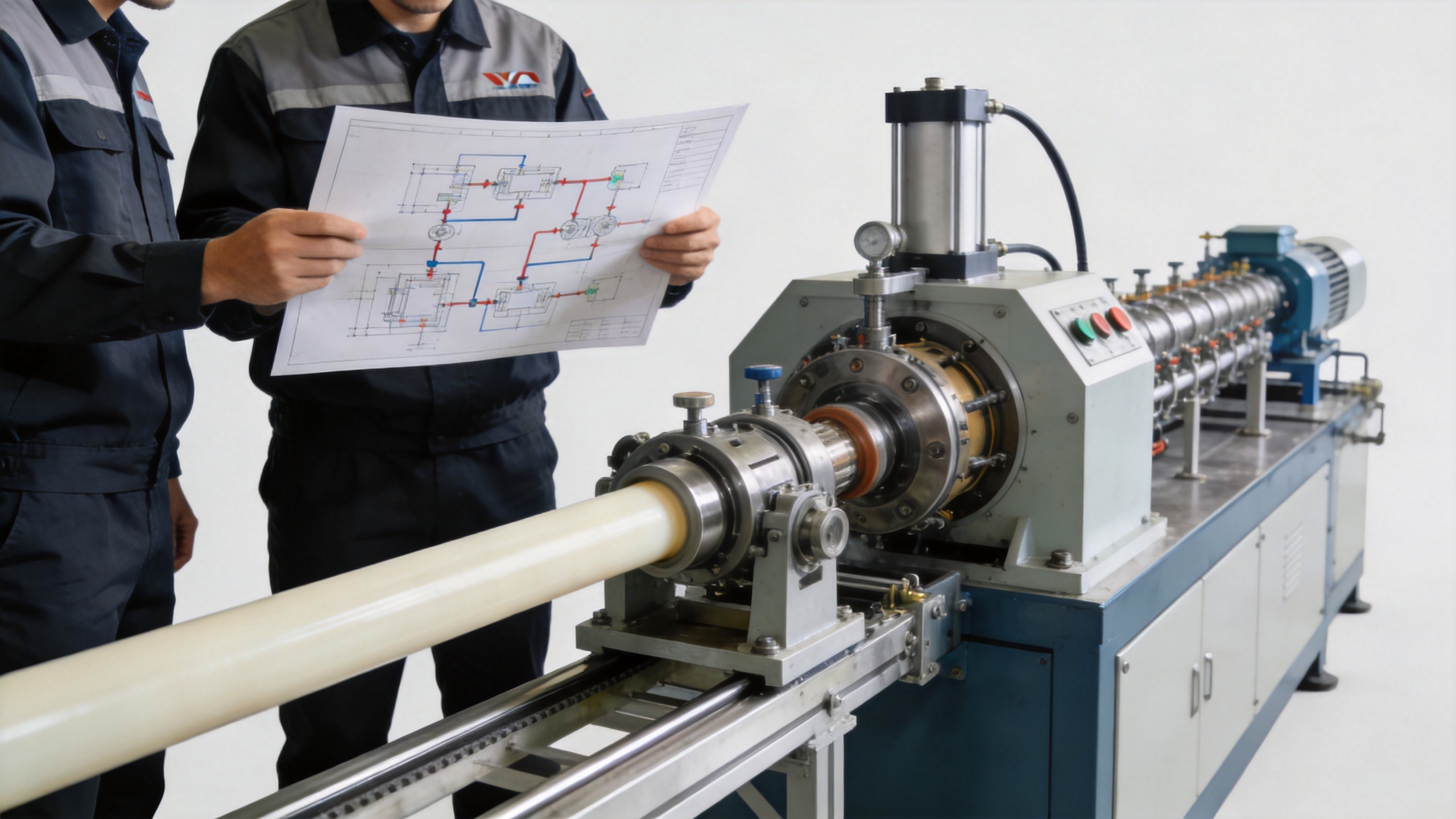
Request a process-flow diagram that names every station, material handoff, measurement point, utility connection, control signal, and operator intervention. For a custom pvco extrusion line, review the responsibility boundary for tooling, gauges, online measurement, scrap handling, and packaging connection boundarys. If an existing plant utility or downstream machine is retained, document the mechanical, electrical, pneumatic, water, and data connection boundarys before release.
Turn orientation risk into measurable trial conditions
The value of a custom pvco extrusion line depends on repeatable orientation, not merely on moving pipe through a stretching section. Controlled thermal and stretching conditions affect how the pipe is formed, so the purchase specification should define the evidence expected during factory acceptance and site commissioning. Avoid accepting broad statements about pipe performance without agreeing on test pieces, sampling frequency, records, and pass/fail ownership.
For the custom pvco extrusion line, ask to see the proposed list of controlled variables: melt condition, temperature zones, forming and orientation settings, line speed, cooling conditions, dimensional measurements, and relevant alarms. The exact set will depend on the project. What matters is that the supplier can show how settings are recorded, how a deviation is noticed, and how the operator returns to a documented condition.
Review capacity claims with a production scenario
Capacity is a commercial risk when a custom pvco extrusion line quotation does not state the pipe size, material, quality assumptions, and operating basis behind the figure. Ask for a scenario table that pairs each claimed output with diameter, wall range, formulation, orientation conditions, yield assumptions, scrap definition, and planned shift pattern. This makes unlike proposals easier to compare.
Also separate transient performance from sustained production. A custom pvco extrusion line may need time for start-up, changeover, stabilization, inspection, and planned maintenance. Your internal financial model should use a documented operating scenario, while the supply contract should state the specific conditions used for acceptance. If the supplier proposes a phased ramp-up, define the evidence and support available at each phase.
Build an acceptance matrix before issuing the purchase order
The central control for a custom pvco extrusion line is an acceptance matrix signed by the buyer and supplier. It should list each requirement, its source, the test method, the required evidence, the location and timing of the test, the responsible party, and the resolution route if results differ. Include documentation, safety interlocks, spare-parts list, drawings, electrical standards, training, utilities, packing, installation scope, and commissioning support alongside pipe-related tests.
For example, the matrix can distinguish factory acceptance from on-site acceptance. A custom pvco extrusion line factory trial may demonstrate agreed conditions using a specified material batch, while site acceptance may confirm installation connection boundarys, operator training, and stable operation under the buyer’s utilities. Define what constitutes a repeat trial, who bears related costs, and whether material changes reset the acceptance baseline.
Evaluate supplier scope, communication, and lifecycle support
Supplier risk is not only a question of machine fabrication. For a custom pvco extrusion line, evaluate the engineering response: Does the proposal identify open technical questions? Does it give drawings, component data, utility consumption assumptions, and a realistic project schedule? Does it define remote support, site-service availability, documentation language, recommended spares, and escalation contacts?
BECHTON states that it supplies turnkey PVC-O pipe production lines in a nominal 110–630 mm range for water-infrastructure applications. That statement should be used as a scope-checking prompt: confirm whether your requested diameter, pipe program, market requirements, and utility conditions fit the proposed configuration. It is more useful to document the confirmed project scope than to infer unlisted capability.
Use a staged decision before releasing a custom pvco extrusion line
A practical release process has four decision stages: requirement freeze, technical annex review, factory acceptance planning, and site-commissioning planning. At each gate, assign an owner and close unresolved points in writing. This approach changes a custom pvco extrusion line decision from a comparison of headline specifications into a managed engineering commitment.
Before placing the order, collect the final pipe requirement sheet, connection boundary drawing, process-flow diagram, material assumptions, capacity scenario table, acceptance matrix, delivery schedule, and service plan in one controlled package. If a condition is unknown, label it as an open risk with a decision date. That discipline gives both parties a clearer basis for configuring, testing, and handing over the custom pvco extrusion line.