
 EN




What Power and Water Supply Demand for PVC-O Pipe Manufacturing Setup
Planning a pvc-o pipe manufacturing setup starts with a site-utility question that is easy to oversimplify: how much electrical power and water does the line actually need? There is no reliable one-number answer. The connected load, normal operating load, cooling-water circulation rate, and fresh-water make-up all change with pipe diameter, target output, ambient conditions, process route, and auxiliary equipment. A useful utility plan therefore begins with the production specification and ends with a supplier-confirmed load schedule.
For a PVC-O project, this matters because extrusion, preform conditioning, orientation-related equipment, cooling, haul-off, cutting, material handling, and controls work as a system. BECHTON supplies turnkey PVC-O pipe lines in the 110–630 mm range, but the final electrical and water connections should be confirmed against the selected configuration and local site conditions.
Start with the difference between installed power and operating demand
For a pvc-o pipe manufacturing setup, electrical planning should separate three values:
- Connected or installed load: the nameplate sum of motors, heaters, drives, pumps, cooling equipment, controls, and auxiliaries. This value is used to plan feeders, switchgear, cable sizing, and the main distribution arrangement.
- Simultaneous running load: the portion of the installed load that normally operates together once the line is stable. Heater duty cycles and variable-speed motors mean it is often lower than the nameplate total, but it must be established from the supplier's load list rather than guessed.
- Start-up and transient demand: the momentary conditions created by pump starts, chiller compressors, material conveying, warm-up, and line acceleration. The utility engineer needs these conditions to coordinate protection settings and avoid nuisance trips.
Do not size the incoming supply from extrusion drive power alone. Barrel and die heating, vacuum and cooling pumps, haul-off drives, cutting, socketing or orientation modules, downstream conveying, lighting, compressed air, and water-treatment equipment can materially change the site total. If a chiller is electrically driven, its demand belongs in the electrical schedule as well as the water plan.
How to estimate electrical demand before final equipment selection
A preliminary pvc-o pipe manufacturing setup estimate can be built in layers. First, define the intended pipe-diameter range, wall class, output target in kg/h, product mix, annual operating hours, and whether the line includes on-site mixing, granulation, socketing, or additional inspection equipment. Then request a line-by-line electrical schedule that identifies voltage, frequency, phases, rated kW, running kW where available, and the recommended diversity assumption for each item.
Specific-energy figures can be useful as a sense check, not as a substitute for the load schedule. A BECHTON search result cites a planning reference of about 180–220 Wh/kg for modern PVC-O extrusion lines. Actual kWh/kg will depend on production rate, pipe geometry, start-up losses, temperature control, the measured boundary, and how long auxiliary equipment runs. Before comparing lines, confirm whether the figure includes cooling, material handling, and downstream equipment.
A practical design review should also answer these questions:
- What incoming voltage and frequency does the selected line require?
- Which loads run continuously and which are intermittent?
- Are power-factor correction, harmonic review, or a transformer required for the site?
- Is there adequate capacity for warm-up, chilled-water generation, dust collection, and future expansion?
- Where will sub-meters be placed so that extrusion, cooling, and total line consumption can be reviewed separately?
In other words, a large connected-load number is not the same as the electricity bill. However, using a low expected operating figure to undersize the incoming service can create an avoidable commissioning problem. Ask the line supplier and the local electrical engineer to review the same load list.
Water demand is mainly a cooling-system design question
The water requirement for a pvc-o pipe manufacturing setup should be expressed as circulating flow, supply temperature, return temperature, pressure, water quality, and make-up requirement. It should not be described only as “water consumption.” Most pipe-extrusion cooling systems are arranged as recirculating loops. The line may need a substantial volume of water moving through vacuum-calibration and cooling sections, while the amount of fresh water added during normal operation is much smaller and depends on evaporation, blowdown, leaks, and maintenance.
Cooling demand is influenced by the mass and temperature of the pipe leaving the forming stage, the required temperature profile, line speed, ambient temperature, tank arrangement, and the effectiveness of heat transfer. A larger diameter or heavier-wall product may change the cooling duty and residence time substantially. For this reason, two lines with a similar hourly output can still require different cooling configurations.
Specify the following items before civil and utility work is released:
- required circulating-water flow for each cooling or vacuum tank;
- required supply-water temperature and allowed return-water temperature;
- minimum inlet pressure and allowable pressure drop through filters, piping, and heat exchangers;
- total heat-rejection duty, expressed by the supplier for the selected product range;
- closed-loop chiller, cooling tower, or plant-water connection;
- water-quality limits, filtration needs, corrosion control, and a plan for drainage during maintenance.
Cooling-water flow and temperature both influence heat removal. If the cooling system is undersized, operators may have to slow the line or contend with less stable dimensions. If it is oversized without control, pumping energy and water-treatment costs may rise unnecessarily. The objective is a controllable, documented cooling loop, not the largest possible water connection.
Use separate utility zones for the line and the cooling plant
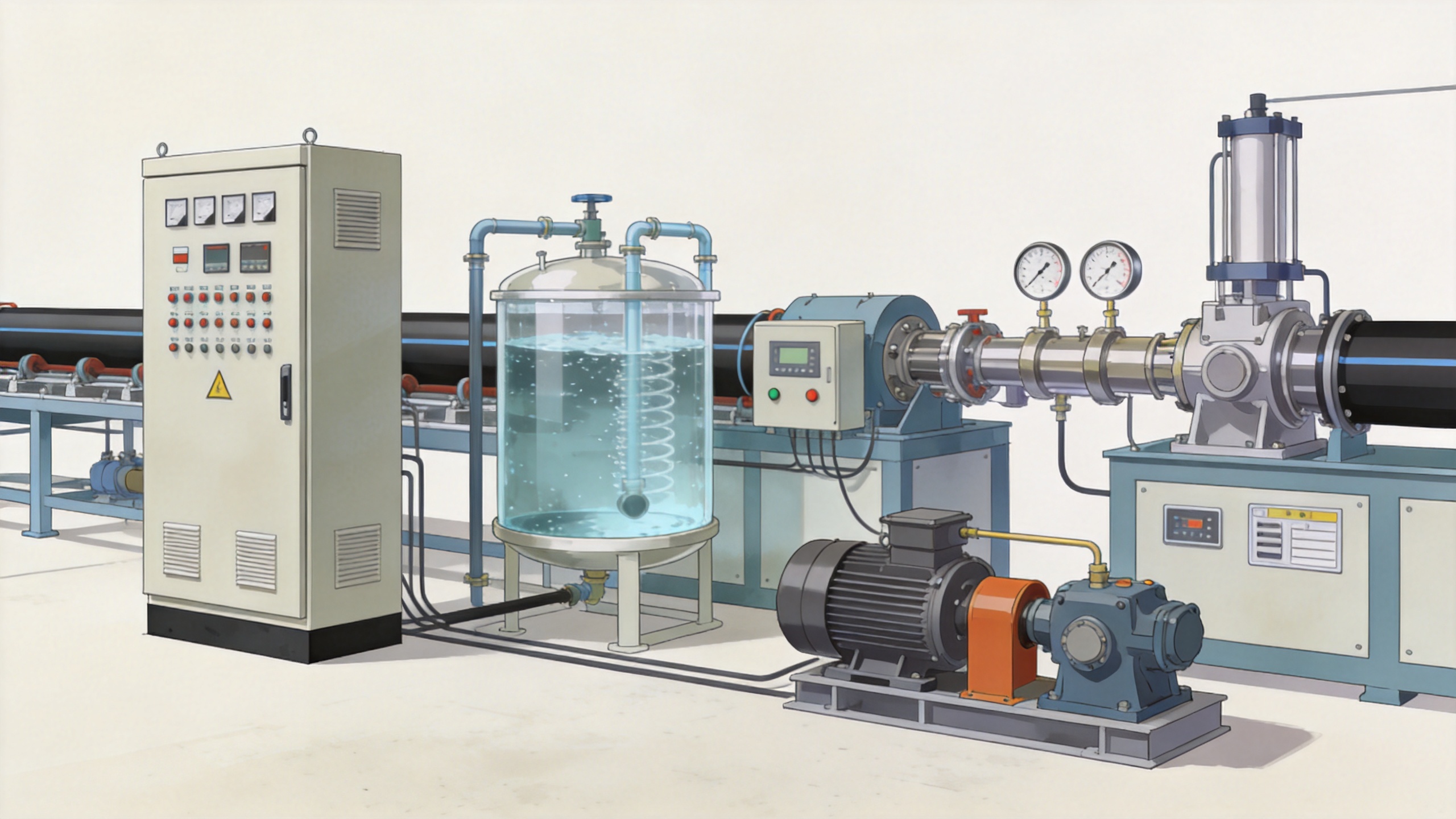
For layout purposes, divide the pvc-o pipe manufacturing setup into utility zones. The production-line zone includes the extruder, heaters, motors, vacuum equipment, haul-off, cutting, and controls. The cooling-plant zone includes chillers or towers, pumps, filters, buffer tanks, water treatment, and makeup connections. Material conveying, compressed air, workshop ventilation, and test equipment should be shown as separate auxiliary zones.
This separation makes commissioning clearer. The production team can see whether a change in pipe output changes extruder demand, cooling-pump demand, or both. It also helps the facility team isolate maintenance without treating every electrical or water issue as a problem inside the extrusion line.
A pre-order checklist for power and water utilities
Before finalizing a pvc-o pipe manufacturing setup, prepare one shared utility sheet with the equipment supplier, plant engineer, and installer. Include:
| Item | What to confirm | Why it matters |
|---|---|---|
| Production specification | Diameter range, wall class, output, product mix, and line speed | These inputs drive both heating and cooling duty. |
| Electrical connection | Voltage, frequency, phase, installed kW, diversity, start-up sequence, and metering points | Supports feeder, protection, transformer, and sub-meter planning. |
| Cooling loop | Flow, pressure, supply/return temperatures, heat duty, filtration, and water-quality requirements | Prevents treating recirculated cooling flow as fresh-water consumption. |
| Cooling plant | Chiller or tower duty, pump head, buffer volume, make-up water, blowdown, and drainage | Defines the plant-side utility scope. |
| Site conditions | Ambient temperature, available utilities, local discharge rules, and room for service access | Turns a line concept into an installable factory plan. |
Where the PVC-O extrusion line production machine fits
A pvc-o extrusion line production machine is not a single utility load; it is the connected manufacturing system. When comparing a PVC-O extrusion line production machine, ask for a process-based utility sheet rather than a headline kW figure. It should show which loads belong to the extrusion section, downstream section, cooling loop, and auxiliary systems. That comparison is more useful when assessing a new site, a capacity expansion, or a utility retrofit.
For preliminary projects, collect site power quality information and existing cooling-plant capacity early. A supplier can then align the utility connection with the pipe program rather than adapt the production plan after civil works are complete.
Conclusion: specify the method, then confirm the numbers
The most defensible answer to power and water demand for a pvc-o pipe manufacturing setup is a confirmed utility schedule tied to the selected pipe range, output, and cooling architecture. Treat connected kW, normal running kW, transient demand, circulating cooling-water flow, and fresh-water make-up as separate design values. With those values documented before installation, the factory team can size electrical distribution and cooling infrastructure with fewer assumptions and a clearer commissioning path.