
 EN
EN



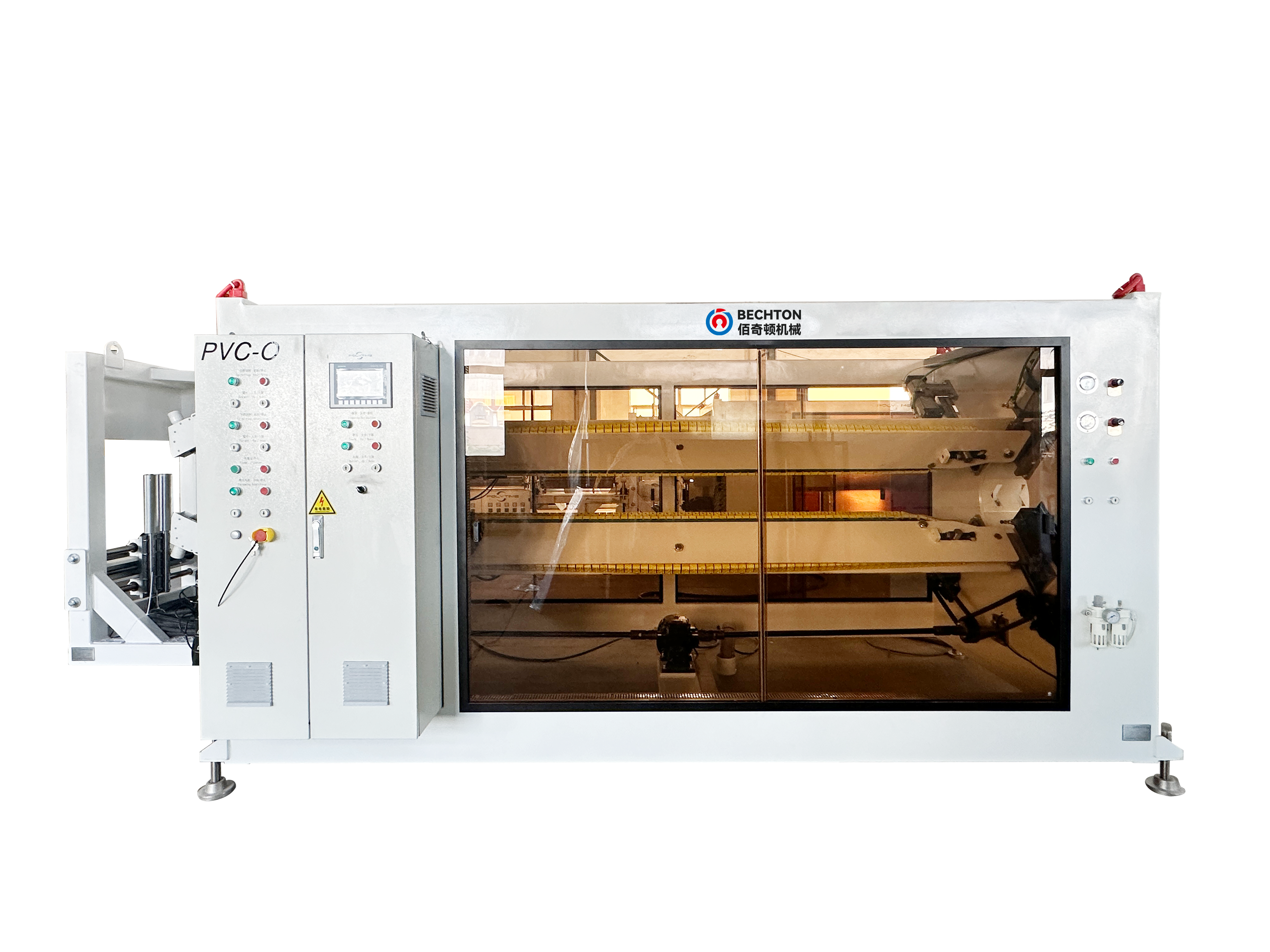
How High-Speed Calibration Ensures Dimensional Precision in PVC-O Pipe
Real-Time Laser Micrometry for OD, Ovality, and Wall Thickness Control
Real-time laser micrometers continuously scan the pipe’s outer diameter, ovality, and wall thickness during extrusion—measuring every millimeter of the moving profile. When deviations exceed ±0.1 mm, the control system adjusts draw-down speed or vacuum pressure within milliseconds. Validated in polymer processing trials, advanced modules deliver 99.7% measurement accuracy across full production runs. This closed-loop feedback eliminates reliance on manual inspection, ensuring consistent dimensional quality, reduced scrap, and higher line speeds—especially critical for large-volume water-supply and irrigation pipe manufacturing. Crucially, detecting and correcting ovality at the calibration stage prevents downstream orientation defects that would otherwise compromise burst pressure performance.
Dual-Chamber Vacuum Calibration Tank: Stability, Cooling Uniformity, and Speed Optimization
The dual-chamber vacuum calibration tank enables staged forming and cooling. In the first chamber, the hot extrudate is drawn against precision-machined sleeves under controlled vacuum to lock diameter and roundness. The second chamber cools the pipe at a precisely regulated rate—typically 2–3°C per second—to minimize residual stresses that could lead to cracking or warping. This two-stage approach ensures uniform wall cooling even at line speeds exceeding 15 m/min for smaller diameters. By stabilizing the melt before biaxial orientation, the tank establishes a geometrically precise starting profile—directly enhancing final hydrostatic strength, impact resistance, and dimensional fidelity without sacrificing throughput.
Synchronized Orientation Unit Integration for Consistent PVC-O Pipe Performance
Coordinated Draw-Down Speed, Tension, and Biaxial Orientation Timing
Uniform molecular orientation in PVC-O pipe depends on tight coordination of draw-down speed, tension, and biaxial stretching timing. Stretching must occur near the glass transition temperature (80–90°C); deviations beyond ±2°C risk chain breakage or incomplete orientation. Axial and circumferential stretch rates must also remain balanced within 1% error to avoid localized thinning or over-stretching. Modern lines achieve this using servo motors and infrared temperature control, enabling microsecond-level adjustments. Synchronizing these parameters ensures even material flow through the orientation unit—delivering identical biaxial deformation along the entire pipe length and guaranteeing repeatable mechanical properties.
Validation Metrics: 98.7% Dimensional Consistency in PVC-O Pipe (ISO 16422-2021)
Compliance with ISO 16422-2021—requiring 98.7% consistency in outer diameter, wall thickness, and ovality—is the definitive benchmark for orientation precision. This translates to fewer than 13 out of every 1,000 measured points falling outside specification, a level routinely achieved by manufacturers using servo-controlled orientation units. Passing ISO 16422 audits confirms the pipe’s predictable performance in pressurized water networks. Without such synchronization, dimensional drift would erode both short-term burst strength and long-term fatigue resistance—undermining the fundamental value proposition of biaxial orientation.
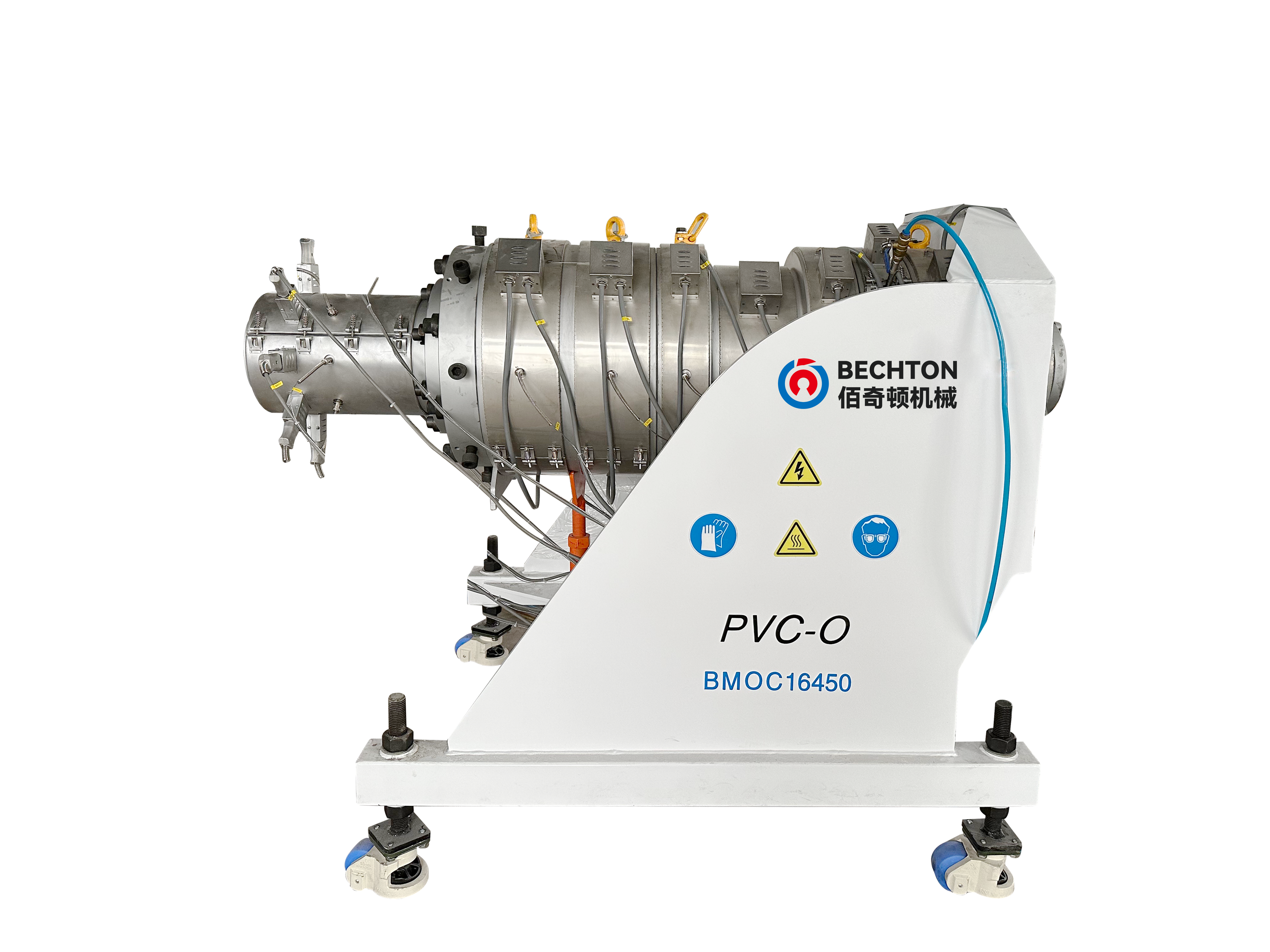
Material-Specific Challenges: Why PVC Demands Unique Calibration and Orientation Strategies
Thermo-Rheological Behavior of PVC During Biaxial Orientation vs. PE/PP
PVC’s thermo-rheological behavior differs fundamentally from PE or PP. While polyolefins orient across a broad temperature range, PVC-O requires biaxial stretching within a narrow window near its glass transition point (80–90°C). Even ±2°C deviation risks irreversible molecular damage or insufficient alignment. Coupled with PVC’s higher melt viscosity, this demands tighter synchronization of axial and circumferential stretch rates—within 1% error—to prevent wall thickness variation. PE/PP’s wider processing tolerance permits simpler mechanical systems; PVC’s sensitivity necessitates real-time infrared temperature feedback and servo-driven coordination to ensure reliable, high-yield production.
Core Components of a Modern PVC-O Pipe Extrusion Line
Gravimetric Feeding, Die Gap Precision, and Air/Vacuum Support Alignment
Gravimetric feeding meters the PVC compound by weight—not volume—ensuring consistent material density and minimizing batch-to-batch variability. Die gap precision then defines the initial molten profile with tight tolerances, directly governing baseline wall thickness uniformity. Simultaneously, coordinated air and vacuum support maintains pipe geometry during sizing, preventing collapse or distortion as the pipe transitions from melt to solid state. Together, these three subsystems form the foundational control layer of a modern PVC-O line—enabling stable, high-output extrusion while preserving the dimensional integrity required for subsequent calibration and orientation.